Categories
Blogs

Churros Mix, Machines and Menus: A Complete India Guide

Churros have moved from Spanish street stalls to Indian cafe menus, wedding counters and mall kiosks. A good churros mix, the right machine and a short, smart menu are all you need to start. Guests love the crunch, the cinnamon sugar and the warm chocolate dip, and the format suits the Indian love of fried, sweet snacks.

This guide walks you through every decision in order. You will compare premix and scratch dough, choose equipment, plan a menu, cost each portion and set up safe daily operations. It is written for cafe owners, caterers and kiosk operators, and it draws on what Just Max has learned building dessert equipment in Kerala since 2002.

Key Takeaways

  • A consistent churros mix and a reliable commercial churros maker matter more than a long menu when you start a churros business in India.
  • Size your churros machine by expected hourly demand, available power and counter space, and confirm three phase supply before you buy.
  • Price every portion from real costs: batter, oil, toppings, packaging, labour and power, then add your margin.

Why Churros Work for Indian Cafes, Kiosks and Events

A churro is a fried dough pastry, piped through a star shaped nozzle and finished with sugar or a dip. It is simple food with a strong visual hook. The ridged shape, the golden colour and the rising steam all draw attention at a busy counter.

Indian customers already love fried sweets, from jalebi to unniyappam. Churros feel familiar yet new, which makes them easy to sell. They also travel well into many formats: a takeaway cone at a mall, a plated dessert in a cafe, or a live counter at a wedding reception.

For operators, churros have three practical strengths. The base batter uses low cost ingredients. One fryer can serve many portions in a short time. Toppings and dips let you charge more for the same base. That combination is why many dessert businesses add churros once their waffle or crepe counter is running well.

Churros also suit the way Indian customers celebrate. Birthday parties, college fests, office events and family weddings all need a dessert that guests can eat while standing and talking. A cone of churros with a small cup of warm sauce fits that need perfectly, and it photographs well for social media.

The market is still young. In many towns, no local cafe sells fresh churros at all. An operator who gets the churros mix, the machine and the service right can own that space before competitors arrive.

Churros also give existing dessert businesses a new reason for customers to visit. A waffle cafe that adds churros can run promotions, launch combos and win back customers who have already tried the rest of the menu. Because the same spreads and sauces serve both products, stock control stays simple.

What Goes into a Churros Mix: Premix or Scratch Dough

Every churro starts with a choux style dough of flour, water, fat and salt, sometimes with sugar or egg. You can make it from scratch each day or start from a ready churros mix. Both routes work. The right choice depends on your volume, your staff and how much consistency matters to you.

Scratch Dough

Scratch dough gives you full control over the recipe. You can adjust sweetness, add spices or develop an eggless version. The trade off is time and skill. Water temperature, mixing time and resting time all change the final texture. On a busy day, small mistakes show up as soft, oily or split churros.

Ready Premix

A ready churros premix removes most of that variation. Staff add water in a fixed ratio, mix and load the machine. Training becomes faster and every batch looks the same. For kiosks, cafes with changing staff and caterers working at unfamiliar venues, a dependable churros mix is usually the safer starting point.
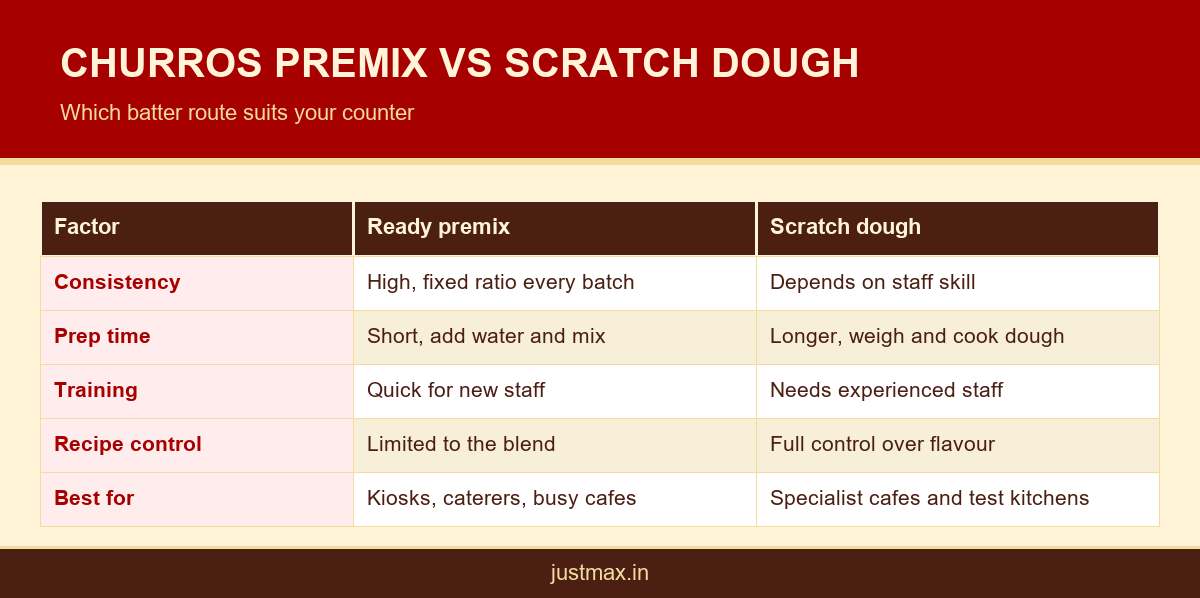
Comparison table of churros mix premix versus scratch dough for commercial kitchens

What to Check in Any Batter

Whichever route you take, test the batter in your own machine before you commit. Run the same test for every churros mix you shortlist, so the comparison is fair. Look for these points:

  • Extrusion: the dough should flow through the cylinder and nozzle without tearing or blocking.
  • Frying: churros should hold their ridges, brown evenly and stay crisp for several minutes after frying.
  • Oil uptake: a good batter absorbs less oil, which improves taste and lowers your running cost.
  • Label and licence: check the FSSAI details, ingredients and allergen information printed on every pack.

Eggless and Dietary Options

Many Indian customers prefer eggless food. If you work from scratch, test eggless recipes carefully, because egg changes texture and structure. If you buy a churros premix, check whether the label states eggless or vegetarian status, and display that clearly at the counter. Label gluten and nut content too, so guests with allergies can choose safely.

Once you choose a churros mix, write the water ratio and mixing time on a card at the station. Small habits like this keep quality steady when a new staff member takes over the fryer.

Choosing a Commercial Churros Machine

Equipment decides how many churros you can serve and how consistent they look. A commercial churros maker usually combines two parts: a cylinder that holds and extrudes the dough, and a fryer that cooks it. Buy for the demand you expect in your second year, not just your first week.

Fryer and Cylinder Capacity

The Just Max commercial churros machine pairs a 25 litre fryer tank with a 2 litre dough cylinder, built in robust stainless steel. The fryer measures 550 mm wide, 650 mm deep and 225 mm high. Just Max describes it as ideal for churros shops with low to medium production and as start up equipment. A larger oil volume keeps temperature steadier when fresh dough goes in, which helps every batch brown evenly.

Power Supply

This churros machine is rated at 10 kW and runs on 440 V, 50 Hz three phase power. Many malls, banquet halls and commercial kitchens have three phase supply, but many small shops and outdoor lawns do not. Confirm the supply in writing before you sign a lease or accept an event booking.

Cutting and Cleaning

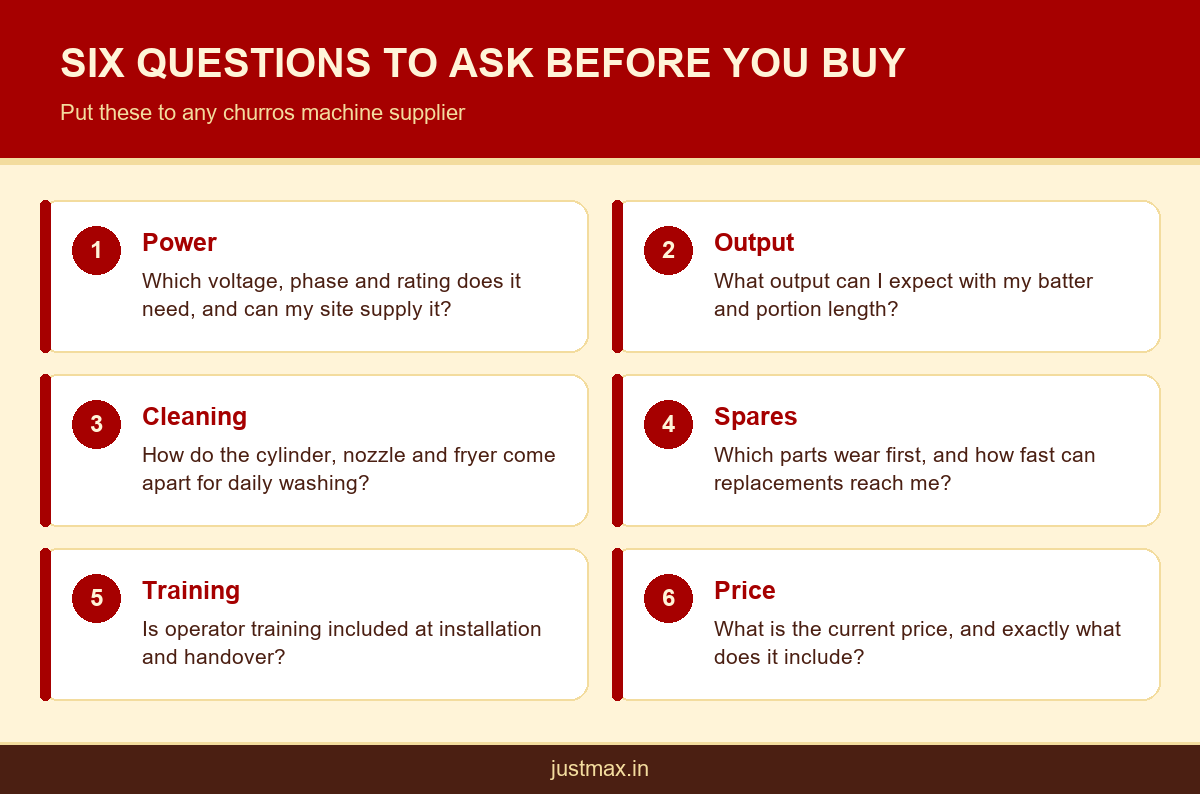
An optional cutting system helps staff cut churros to an even length, which keeps portions consistent and costing accurate. Stainless steel surfaces make daily cleaning easier. Ask any supplier how the cylinder and nozzle come apart, how the oil drains and which parts need regular replacement.

Ventilation and Placement

Frying produces heat, steam and oil vapour. Place the machine under a suitable exhaust hood where your venue requires one, and keep a safe gap from walls, curtains and customer areas. Set the fryer on a sturdy, level, heat resistant surface at a comfortable working height. Plan where oil will be stored, filtered and disposed of before the machine arrives.

Ask for current pricing and output figures directly, because output depends on your batter, frying time and cutting length. If you are comparing several snack machines at once, our guide to dessert and snack equipment beyond waffles puts churros in context alongside other formats.

Building a Churros Menu That Sells

Start with a short menu. Three or four options are enough to look generous without slowing the queue. Build every item from the same base churro and change only the finish, so your churros mix and fryer routine stay the same.
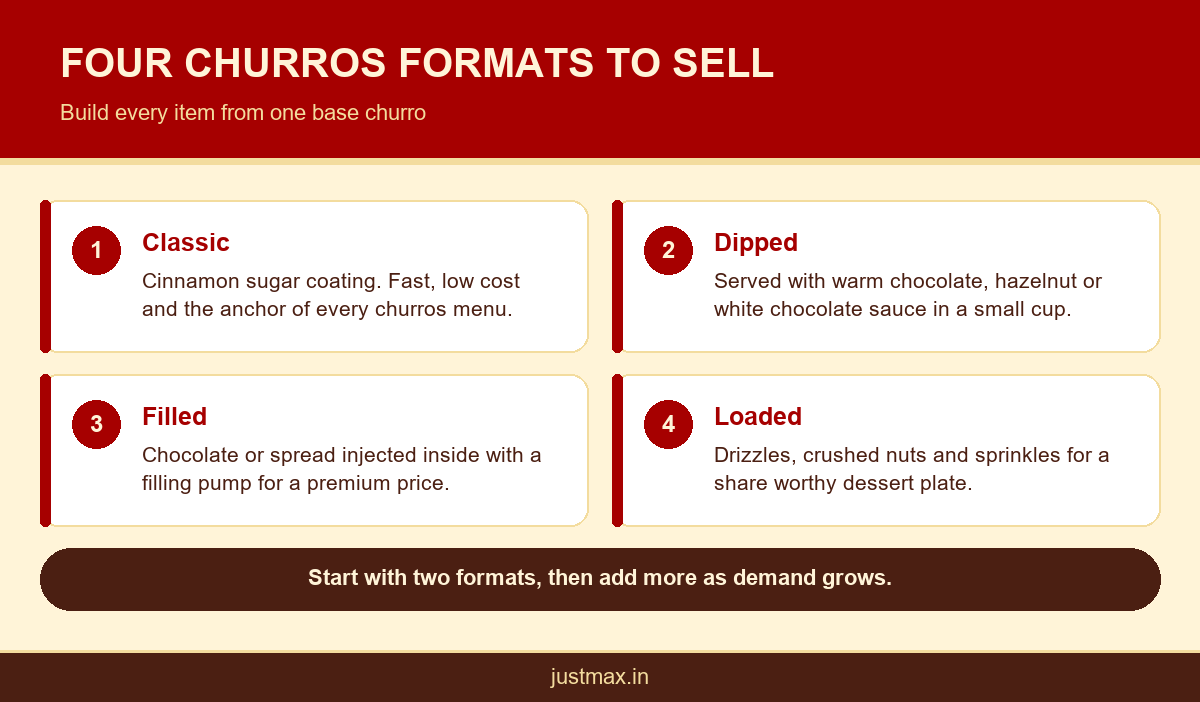
Infographic showing four churros menu formats: classic, dipped, filled and loaded

Classic cinnamon sugar churros are the anchor. Dipped churros add a cup of warm chocolate, hazelnut or white chocolate sauce. Filled churros use a chocolate filling pump to inject chocolate or spread inside each piece. Loaded churros add drizzles, crushed nuts and sprinkles for a premium price.

Spreads make the menu easy to expand. A small range of Just Max chocolate and nut spreads covers milk chocolate, dark chocolate, white chocolate, hazelnut, pistachio and cookie flavours. Keep sauces warm in bottle warmers for dips and drizzles so they pour smoothly through a long shift.

Think about pack formats too. Cones and paper boats suit kiosks and events. Plates suit cafes. Sharing boxes of eight to ten churros with two dips work well for groups and delivery orders, although churros lose crispness quickly, so keep delivery distances short.

Seasonal specials keep regulars coming back. Try a pistachio drizzle for Eid, a cinnamon and jaggery sugar for Onam or a red and white dip pairing for Christmas. Each special uses the same base, so the extra work is small.

Indian flavour twists help churros feel local. Cardamom sugar, a light chai masala dusting or a jaggery caramel dip can all sit beside the classic cinnamon. Test each twist as a weekend special before adding it to the main board, and keep the base churros mix unchanged so the batter routine stays simple.

Combos lift the bill size without extra work. Pair a churros cone with a cold coffee or a milkshake, or offer a family box with three dips. Display the combo price clearly next to the single portion, so guests can see the saving. Combos also make it easier to predict daily batter and spread use.

Fix a standard portion before launch, for example a set number of pieces of a set length per cone. Show the portion to every staff member and check it during service. Consistent portions protect your margin and make every order look the same.

Costing and Pricing Every Portion

Price churros from your own numbers, not from a competitor’s menu board. Your cost per portion depends on batter yield, portion size, oil life, toppings and packaging. Track each one for a week and you will know your real figure.

Cost item How to measure it Practical tip
Batter Cost of churros mix or ingredients divided by portions per batch Weigh dough per portion for a week
Oil Cost of oil divided by portions fried before each change Filter daily to extend oil life
Toppings and dips Spread or sauce used per portion Use a fixed scoop or squeeze count
Packaging Cone, boat, cup and napkin per order Buy in bulk once formats settle
Labour and power Staff hours and machine running hours per day Divide by average daily portions

Add these together for your cost per portion. Then decide your target margin and set the menu price. As a rule of thumb, premium options such as filled or loaded churros should carry a higher margin than the classic, because guests see more value in them.

Review your numbers every month. Oil prices, packaging costs and footfall all change, and a small drift in portion size can quietly erase your profit. A simple spreadsheet updated each Sunday is enough for most kiosks and cafes.

For events, quote per guest rather than per portion. Estimate how many guests will visit the counter, multiply by an average of one to two portions as a planning rule of thumb, and add a buffer for second helpings.

Watch for three common costing mistakes:

  • Ignoring oil: oil is often one of the largest costs after batter, so track it from day one.
  • Free extra dips: an extra cup of sauce given away with every order adds up quickly over a month.
  • Closing wastage: batter mixed late in the day and thrown away belongs in your cost per portion.

If you sell through food delivery apps, add the commission and special packaging to your cost per portion. Churros soften as steam builds inside closed boxes, so use vented packaging, pack dips separately and limit delivery to short distances. Some operators keep churros as dine in and takeaway only for this reason.

Operations: Oil, Hygiene and Staffing

Good churros depend on steady oil temperature and clean oil. Preheat fully before the first batch. Fry in small batches so the temperature does not drop sharply. Skim crumbs often and filter the oil at the end of each day. Change it when it darkens, smokes early or starts to taste stale.

Fry churros until they are evenly golden and crisp, then drain them well before coating. Coat classic churros in cinnamon sugar while they are still warm, so the sugar sticks. Serve immediately, because churros taste best within minutes of leaving the fryer.

Food safety comes next. Every food business in India needs FSSAI registration or a licence, which you can apply for on the FSSAI FoSCoS portal. Follow the WHO guidance on food safety: keep clean, keep raw and ready food apart, and hold food at safe temperatures.

  • Keep mixed batter covered and use it within the time stated on the churros premix pack.
  • Use separate utensils for each dip and label nut based spreads clearly for guests with allergies.
  • Keep a fire blanket and the correct extinguisher near the fryer at all times.
  • Train every operator on start up, shut down, oil handling and daily cleaning.

Staffing is simple. One trained operator can run the fryer at a quiet kiosk. Busy cafes and events need a second person for toppings, packing and billing. Rotate staff away from the fryer during long shifts, because heat and steam are tiring and tired staff make mistakes.

Write a one page standard operating procedure covering preheating, batter ratio, frying time, portion length, toppings and cleaning. Laminate it and keep it at the station. It is the cheapest quality control tool you will ever buy.

A simple daily routine helps. At opening, check oil level and quality, preheat the fryer, mix the first batch of batter, warm the dips and set out packaging. At closing, switch off, let the oil cool, filter it, clean the cylinder and nozzle, wipe every surface and record the portions sold and oil used. Daily records show exactly when oil needs changing and when stock needs ordering.

Where Churros Fit: Cafes, Kiosks and Events

Churros adapt to almost any format, but each one needs a slightly different plan.

Cafes

Cafes can add churros as an afternoon snack and an after dinner dessert. Pair them with coffee, hot chocolate or cold coffee to raise the average bill. Because a cafe already has a counter, staff and regular customers, churros are a low risk addition. Start with two formats and watch which time of day sells best.

Kiosks

Kiosks in malls, food courts and transit hubs depend on speed and visibility. Place the machine where customers can watch the dough being piped and fried, because the show sells the product. Keep the menu board short, offer cones and cups for walking customers, and prepare dips before the evening rush. Check the mall’s rules on frying, ventilation and three phase power before you sign.

Events

Event caterers can run churros as a live counter at weddings, college fests, corporate days and birthday parties. Guests enjoy watching the fryer, and churros are easy to eat while standing. Quote per guest, carry enough batter and oil for the full service window, and staff every churros counter with two people.

For events, plan power and space early. Our guide to running a live dessert counter at events covers queue flow and batter holding that apply equally to churros. If you are building a catering business from scratch, read about starting a dessert catering business in Kerala for licences and first event planning.
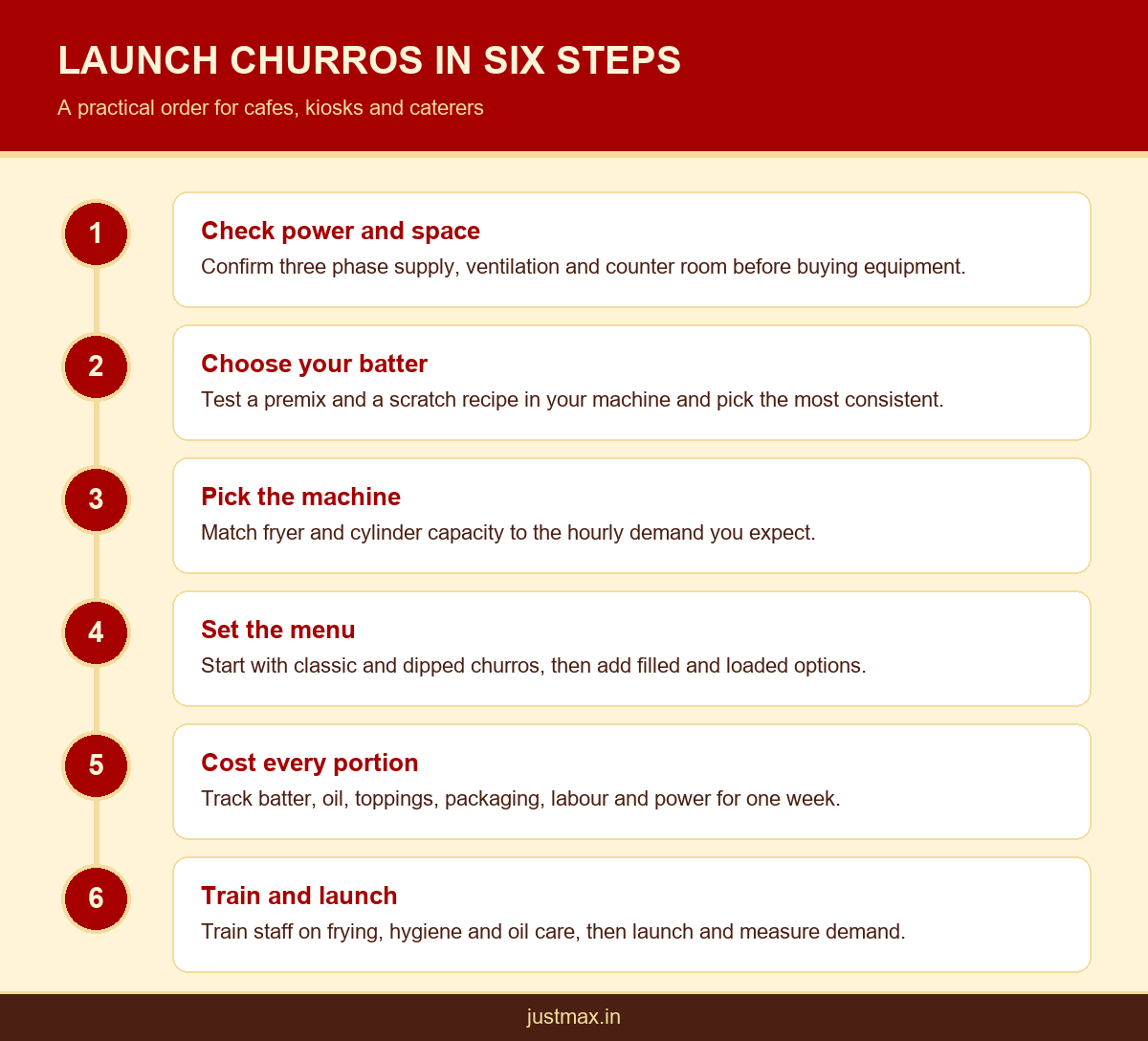
Six step flow for launching a churros business in India, from power checks to launch

Whatever the format, start small, measure demand for a month and then expand. A churros business in India grows best when each step is backed by real sales data rather than guesswork.

Getting Support from a Manufacturer

A churros station is an investment, so after sales support matters. Just Max manufactures its equipment at its own factory in Mavelikara, Kerala, with an office in Kakkanad, and offers life long post sales service on its machines. That means genuine parts, technicians who know the equipment and practical advice on installation and daily care.

Ask whether operator training is included at handover. Even experienced cooks benefit from a short session on the exact settings, cleaning steps and safety checks for a specific machine. Record the session on a phone so new staff can watch it later, and keep the user manual at the station rather than in the office.

Ask your supplier for a walkthrough before you buy. Learn how to assemble the cylinder, set the fryer, clean the nozzle and store the machine. A clear handover saves you from early mistakes and keeps your churros consistent from the first day.

Spares matter too. Ask which parts wear first, such as seals, nozzles and heating elements, and keep a small spare kit at the shop. A churros machine that stops on a Saturday evening costs you the busiest sales of the week, so plan a quick repair path before you need it.

Plan the complete station rather than a single machine. A compact dipping station, warm sauce holders and a stock of spreads turn a basic fryer into a full dessert counter that earns more from every guest.

Conclusion

Selling churros in India comes down to four things: a dependable churros mix, the right machine for your power and volume, a short menu with smart dips, and clean daily operations. Get these right and churros can become one of the most profitable lines on your counter.

Ready to plan your churros station? Talk to the Just Max team about machines, spreads and sauce warmers, or message us on WhatsApp at +91 88480 43729.

Frequently Asked Questions

What is a churros mix?

A churros mix is a ready blend of flour and other dry ingredients for churro dough. You add water in a fixed ratio, mix and pipe it, which saves time and keeps texture consistent between batches and staff.

Is premix better than scratch dough for churros?

Premix suits busy kiosks, cafes and caterers because it reduces training and variation. Scratch dough offers more recipe control but needs skilled staff. Test both in your own machine before deciding which works best for your counter.

What power does a commercial churros machine need?

The Just Max churros machine is rated at 10 kW and runs on 440 V three phase supply. Many small shops lack three phase power, so confirm the supply with your landlord or venue before you buy.

How many churros can one machine make per hour?

Output depends on batter, portion length, frying time and staff speed. Ask your supplier for figures using your batter, then run a timed trial. Plan your menu and staffing around that real number, not a brochure figure.

Which dips sell best with churros?

Warm milk chocolate is the classic, followed by hazelnut, white chocolate and pistachio. Offer two or three dips at most to keep service quick, and hold them warm in bottle warmers so they pour smoothly all day.

Do I need an FSSAI licence to sell churros?

Yes. Every food business in India needs FSSAI registration or a licence depending on its scale. Apply through the FoSCoS portal, display your number at the counter and keep certificates ready for malls and event organisers.

How often should I change frying oil?

Filter oil daily and change it when it darkens, smokes early, foams or tastes stale. Frying smaller batches at the correct temperature and skimming crumbs regularly extends oil life and keeps churros crisp and golden.

Can I buy churros equipment through a local dealer?

Yes. Just Max works with authorised partners across India. Check the Just Max distributor network to find local support near you, or contact the factory directly for buying advice, product walkthroughs, staff training and life long post sales service.

Can churros work alongside waffles on one counter?

Yes. Many dessert counters pair churros with multi waffle machines and share the same spreads and sauces. Plan power and space for both machines, keep separate prep areas for each batter and train staff on both stations.
Categories
Blogs

Commercial Churros Machine Guide: Capacity, Power and Output

A commercial churros machine is the heart of any churros counter. It decides how fast you serve, how even each churro
looks and how much power your shop needs. Choose well and the machine pays for itself through steady daily sales.

This guide explains fryer and cylinder capacity, power supply, output planning, placement and care. It uses the Just
Max churros machine as a worked example, and it builds on our
complete guide to selling churros in India.

Key Takeaways

  • Check fryer volume and cylinder size against the number of portions you expect in your busiest hour.
  • Confirm three phase supply and ventilation before buying any churros maker machine.
  • Ask for real output figures with your own batter, then plan staff and menu around a timed trial.

What a Commercial Churros Machine Does

A churros maker machine has two working parts. A cylinder holds the dough and pushes it through a star shaped nozzle.
A fryer cooks the extruded dough until it turns golden and crisp. Some machines add a cutting system so staff can cut
each churro to the same length.

Home churro makers are built for a few portions at a time. A commercial unit is built for hours of continuous frying,
frequent refills and daily cleaning. That difference shows up in oil volume, build quality, power rating and the way
parts come apart for washing.

The Just Max churros machine is a robust stainless steel industrial
unit. Just Max describes it as ideal for churros shops with low to medium production and as start up equipment for new
businesses.

Buying the right size also protects your margin. An oversized machine wastes oil and power on quiet days, while an
undersized one creates queues and lost sales on busy ones. Start by estimating your busiest hour, then choose
equipment that handles it comfortably with room to grow over the next year.

Fryer Capacity, Cylinder Size and Build

Oil volume matters more than most buyers expect. When cold dough enters hot oil, the temperature drops. A small tank
drops further and takes longer to recover, which leads to pale, greasy churros. A larger churros fryer holds heat
better and keeps colour consistent through a rush.

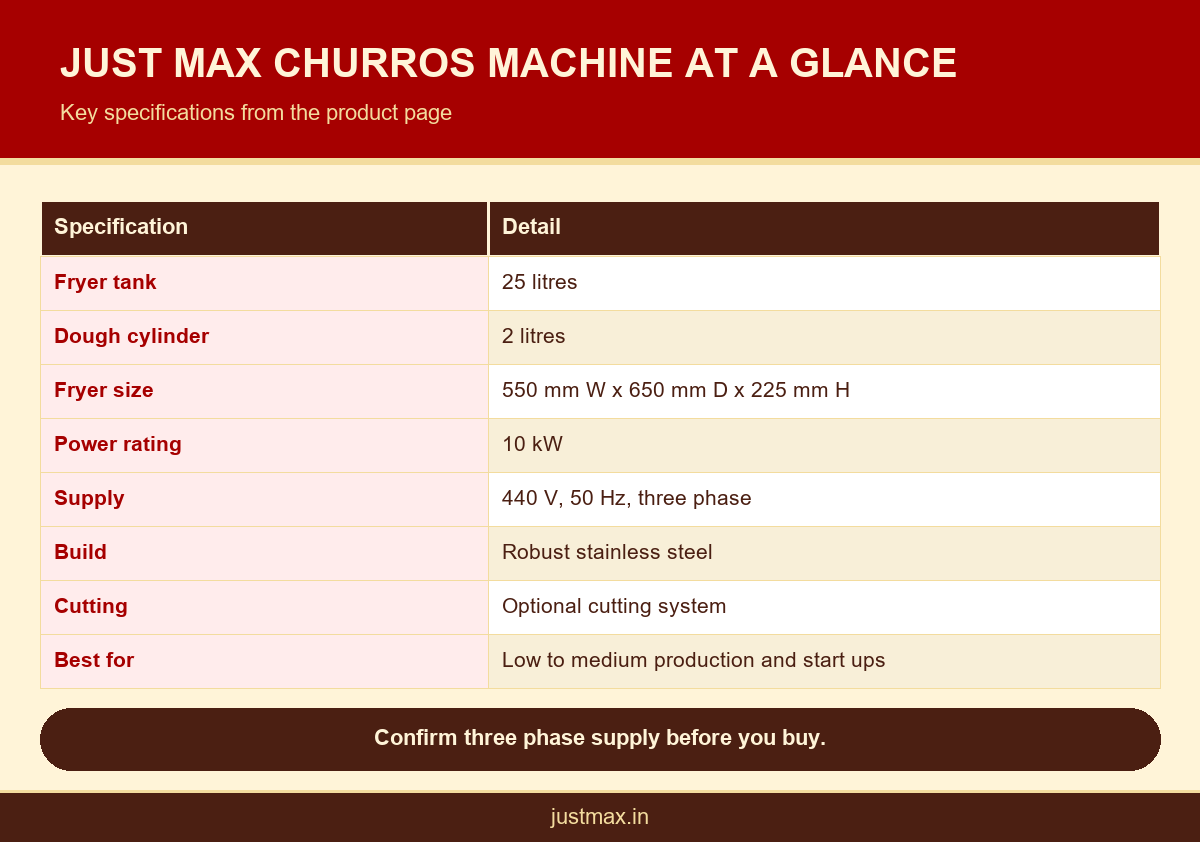
Specification table for the Just Max commercial churros machine showing fryer, cylinder and power

The Just Max unit pairs a 25 litre fryer tank with a 2 litre dough cylinder. The fryer measures 550 mm wide, 650 mm
deep and 225 mm high, so plan a counter that fits it with working space on each side. Stainless steel construction
resists corrosion from oil and frequent washing.

The 2 litre cylinder decides how often staff refill dough. Prepare batter in batches that match the cylinder, so fresh
dough is always ready and nothing sits out for long. An optional cutting system helps staff cut every piece to the
same length, which keeps portions and costing accurate.

Ask how the cylinder is loaded and how much pressure staff need to apply. A smooth, controlled extrusion keeps ridges
sharp and avoids hand fatigue over a long shift. Check that the nozzle is easy to remove and that spare nozzles are
available, because a damaged nozzle changes the shape of every churro.

Power, Ventilation and Placement

This commercial churros machine is rated at 10 kW and runs on 440 V, 50 Hz
three phase power. That is the first check
before you buy. Many malls, hotels and commercial kitchens have three phase supply, while many small shops and homes
do not. Ask your landlord or electrician to confirm it in writing.

For events, the same rule applies. A lawn or temporary venue needs a generator that supports three phase load. Our
guide to
planning outdoor dessert counters in Indian summers
explains how to size generators and route cables safely.

  • Place the fryer on a sturdy, level, heat resistant surface at a comfortable working height.
  • Keep a safe gap from walls, curtains, cables and customer areas.
  • Install suitable exhaust where your venue or local rules require it.
  • Keep a fire blanket and the correct extinguisher within easy reach.

Plan oil handling too. A 25 litre tank holds a heavy load of hot oil, so decide how staff will fill, drain, filter and
store it safely. Use sturdy containers with lids, never move the fryer while the oil is hot, and agree with your
landlord how used oil leaves the premises.

Planning Hourly Output Realistically

Every buyer asks how many churros a machine makes per hour. The honest answer depends on your batter, portion length,
frying time and staff speed. Brochure figures rarely match a busy evening with a long queue.

Run a timed trial instead. Fry ten standard portions with your own batter, note the minutes from first drop to last
serve, and calculate portions per hour. As a planning rule of thumb, base staffing and menu decisions on about three
quarters of that trial figure, because real service includes refills, cleaning and customer questions.

If your trial shows demand will exceed one machine, plan a second station rather than rushing frying times.
Undercooked churros lose their crunch quickly and damage repeat sales.

Batter choice affects output as well. A consistent premix extrudes and fries the same way every time, so your trial
figure stays reliable from week to week. A scratch dough that varies by batch will also vary in frying time, and your
planning numbers will drift. Whichever batter you use, repeat the timed trial whenever you change recipe, supplier or
portion length, and update the staff rota to match the new figure.

Remember the full counter. Dips and drizzles slow service when they sit in open bowls. Keep sauces in
bottle warmers beside the fryer so staff
can finish each order in seconds.

Track demand by hour for the first month. Most kiosks see sharp peaks after lunch, in the early evening and on
weekends. Prepare batter and dips ahead of those peaks and put your strongest operator on the fryer. Over time, the
data shows whether a second machine or extra staff is the better investment.

Six questions to ask before buying a commercial churros machine

Cleaning, Care and Price

Daily care keeps output high. Clean the cylinder and nozzle at the end of every shift, before dough dries inside.
Filter oil daily and change it when it darkens or smokes early. Wipe all stainless steel surfaces and check seals for
wear each week.

Food safety follows the same basics as any fryer station. Keep batter covered, use clean utensils and follow the
WHO guidance on food safety. Write a short
cleaning checklist and keep it at the station where every shift can see it.

Build a weekly maintenance habit as well. Inspect cables and plugs for heat damage, check that the thermostat responds
correctly, tighten loose fittings and look for wear on seals and gaskets. Note every issue in a simple logbook. When
you call for service, the log helps the technician find the problem faster.

On cost, buyers searching for a churros machine price in India should know that Just Max shares pricing on enquiry
rather than listing it online. Compare quotes on total value: build quality, oil capacity, power needs, cutting
options, training and spares. A cheaper unit that waits weeks for a part during peak season costs more than it saves.

Before payment, ask for a GST invoice, the user manual, warranty terms and a named service contact. Keep copies at the
shop and on your phone. Clear paperwork makes warranty claims simple and helps if you ever resell or upgrade the
machine.

If you are weighing churros against other snack formats, our
guide to dessert and snack equipment beyond waffles
compares the options side by side.

Conclusion

The right commercial churros machine matches your peak demand, your power supply and your counter space. Check fryer
volume, cylinder size and three phase power first, then run a timed trial with your own batter before you plan staff
and menu.

Ready to plan your churros station?
Ask the Just Max team for a quote and walkthrough, or message us on WhatsApp
at +91 88480 43729.

Frequently Asked Questions

What is the price of a commercial churros machine in India?

Prices vary by capacity, build and features. Just Max shares its churros machine price on enquiry, so contact the team
with your expected output and power supply to receive a current quote and specification sheet.

Does a churros machine need three phase power?

Heavier commercial units often do. The Just Max churros machine is rated at 10 kW on 440 V three phase supply. Confirm
your shop or venue supply in writing before you buy or accept an event booking.

How much oil does a churros fryer hold?

The Just Max machine has a 25 litre fryer tank. A larger oil volume keeps temperature steadier when fresh dough goes
in, which helps churros brown evenly and stay crisp through every busy service period.

Can one person run a churros machine?

Yes. At a quiet kiosk, one trained operator can fry, coat and serve. Busy cafes and events need a second person for
dips, packing and billing, so the queue keeps moving smoothly during peak hours.

How do I clean a churros machine?

Switch off and let the oil cool. Clean the cylinder and nozzle before dough dries, filter the oil, wipe stainless
surfaces and check seals. Follow the manual and keep a short cleaning checklist at the station.

Is a churros machine suitable for events?

Yes, if the venue can supply the right power and space. Plan a generator for outdoor events, keep the fryer away from
guests and staff the counter with two trained people for smooth, safe service.

Who services Just Max churros machines?

Just Max manufactures its equipment in Mavelikara, Kerala, and offers life long post sales service. Learn more about
the Just Max factory and team and the support, spares and training available
to equipment buyers across India.

Can I buy a churros machine through a dealer?

Yes. Just Max works with authorised partners, so check the
Just Max distributor network for local support. You can also buy
directly from the factory for buying advice, current quotes, installation guidance and staff training.

Categories
Blogs

Live Pancake Station for Events: Layout, Batter and Menu

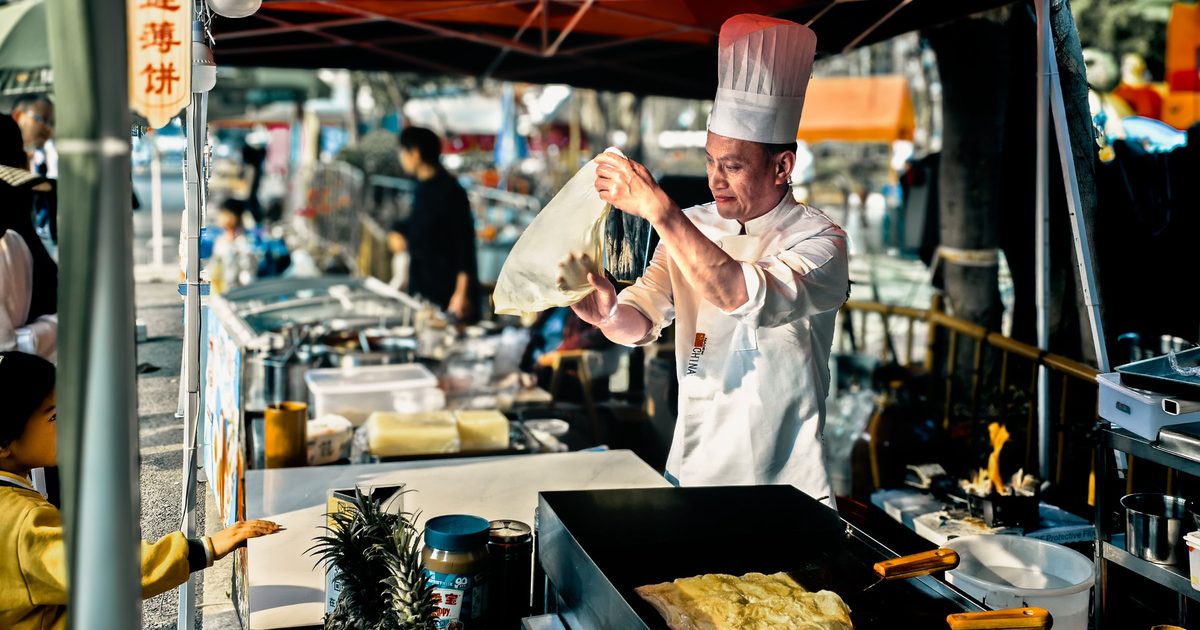
A live pancake station turns dessert into a show. Guests watch batter hit a hot plate, choose a topping and walk away with something made just for them. For caterers, that theatre only works when the counter runs smoothly.

This guide covers the operational side of running commercial crepe makers and pancake setups at events. You will learn how to lay out the counter, hold batter safely, keep the queue moving and plan a menu your team can deliver at pace.

Key Takeaways

  • A live pancake station succeeds on layout and preparation, not only on equipment. Plan a one-way guest path from order to hand-off.
  • Keep batter chilled, mix in small batches and record mixing times. This protects guests and keeps texture consistent across a long event.
  • Build a short menu around one hero format, such as crepes or mini pancake catering cups, and choose toppings that hold well.

Why Live Counters Work at Indian Events

Indian weddings, receptions and corporate events now expect at least one live dessert counter. Guests enjoy the freshness and the personal touch. A pancake or crepe counter also suits mixed age groups, because children and adults both find something they like.

The format is flexible. A crepe station for events can serve folded crepes with spreads and fruit. A mini pancake counter can serve cups or sharing boxes. Both use simple batter, so menu costs stay predictable. If you are still choosing equipment, our plate size and power guide for crepe makers covers the buying decision in detail. This article focuses on running the counter once the equipment is booked.

Live counters also give the host a talking point. Guests photograph the cooking, share it and come back for a second plate. For a caterer, that visibility is free marketing at every booking. It also lets you charge a premium over a plated dessert, because guests value the experience as much as the food.

The risk is that a live counter becomes a bottleneck. One slow station can create a long queue that guests remember more than the food. Good planning removes that risk before the first guest arrives.

Live Pancake Station Layout: Plates, Holding and Queue Flow

Treat the counter as a small production line. Every item should sit within one step of the person who needs it. Chefs call this mise en place, and it matters even more when guests are watching.

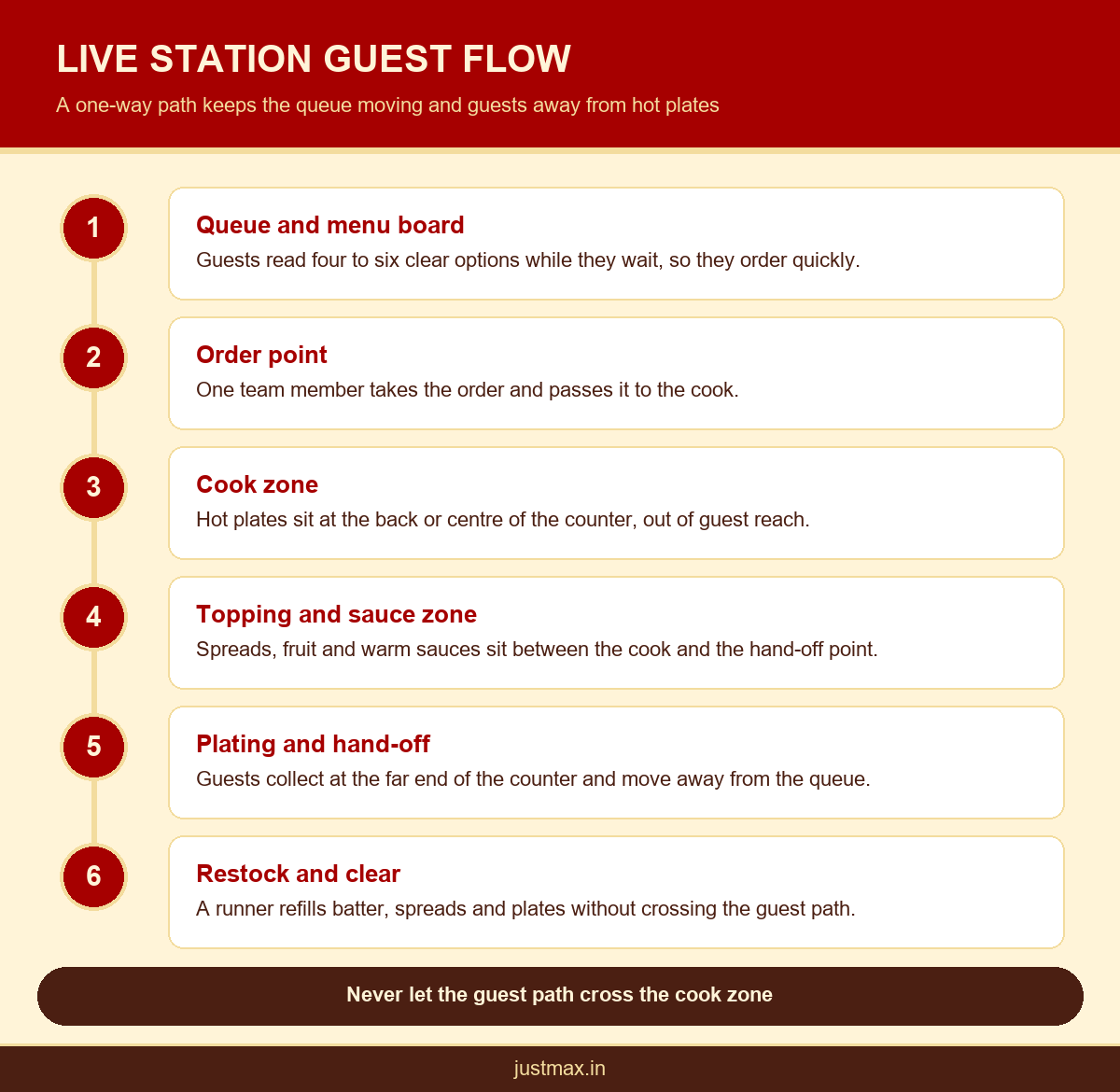
Start with the guest path. Guests should join the queue, see the menu board, order and then collect at the far end. They should never cross in front of the cook zone. Place the hot plates at the back or centre of the counter, away from guest hands. Keep toppings and sauces between the cook and the hand-off point.

Infographic showing the one-way guest flow for a live pancake station at an event

Power is the next check. Confirm the supply at the venue before the event, not on the day. Give every crepe maker and multi waffle machine its own outlet where possible. Shared extension boards are a common cause of tripped circuits during peak service.

Assign clear roles before service. One person cooks and controls the plates. A second person handles toppings, plating and the hand-off. At larger events, a runner restocks batter, spreads, cups and napkins from the back. Clear roles stop two people reaching for the same plate and keep the counter calm when the queue grows.

Plan sauce holding as part of the layout. Warm chocolate and caramel need a dedicated spot, so the cook never waits for a microwave. A bottle warmer beside the topping zone keeps sauces pourable through the evening.

Finally, estimate your output honestly. Brochure figures rarely reflect a busy event. As a planning rule of thumb, run a timed dry run with your actual staff. Cook ten portions, note the minutes and plan your guest count from that real figure. If you need far more output than one plate can give, read about when a pancake machine makes sense before you confirm the booking.

Batter Holding and Food Safety on the Counter

Batter is the heart of the counter, and it is also the biggest food safety risk. Most batters contain milk, eggs or both. Once mixed, they behave like any other perishable food.

Follow the simple principles in the WHO fact sheet on food safety. Keep cold food cold and hot food hot. The WHO Five Keys guidance advises holding perishable food below 5°C and not leaving cooked food at room temperature for more than two hours.

  • Mix in small batches. Prepare only what you expect to use in the next hour, then mix fresh.
  • Hold batter on ice. Set the batter jug or dispenser in a tray of ice behind the counter.
  • Label every batch. Write the mixing time on tape so any team member can check it.
  • Discard, never top up. Do not pour fresh batter on top of an old batch.
  • Keep spreads covered. Close spread tubs between orders to keep out dust and insects at outdoor venues.

Premixes help here. A consistent premix needs fewer ingredients at the venue, so there is less handling and less room for error. Just Max waffle and pancake premixes come in Vanilla, Chocolate (Brownie) and Red Velvet, which lets you offer variety from one simple mixing routine.

Allergens need attention too. Batter usually contains wheat and milk, and some spreads contain nuts. Display a simple allergen card at the menu board. Keep a separate spatula and spoon for nut spreads, and clean the plate between orders when a guest asks for a plain option. Wipe the counter and plates on a fixed schedule during long events, not only at the end.

Brief your team before service. Every person on the counter should know the holding rules, the hand washing point and who decides when a batch is discarded.

Menu Planning for Crepe and Mini Pancake Catering

A short menu serves faster and sells better at events. Guests decide quickly when the board shows four to six clear options. Long menus slow the queue and increase waste.

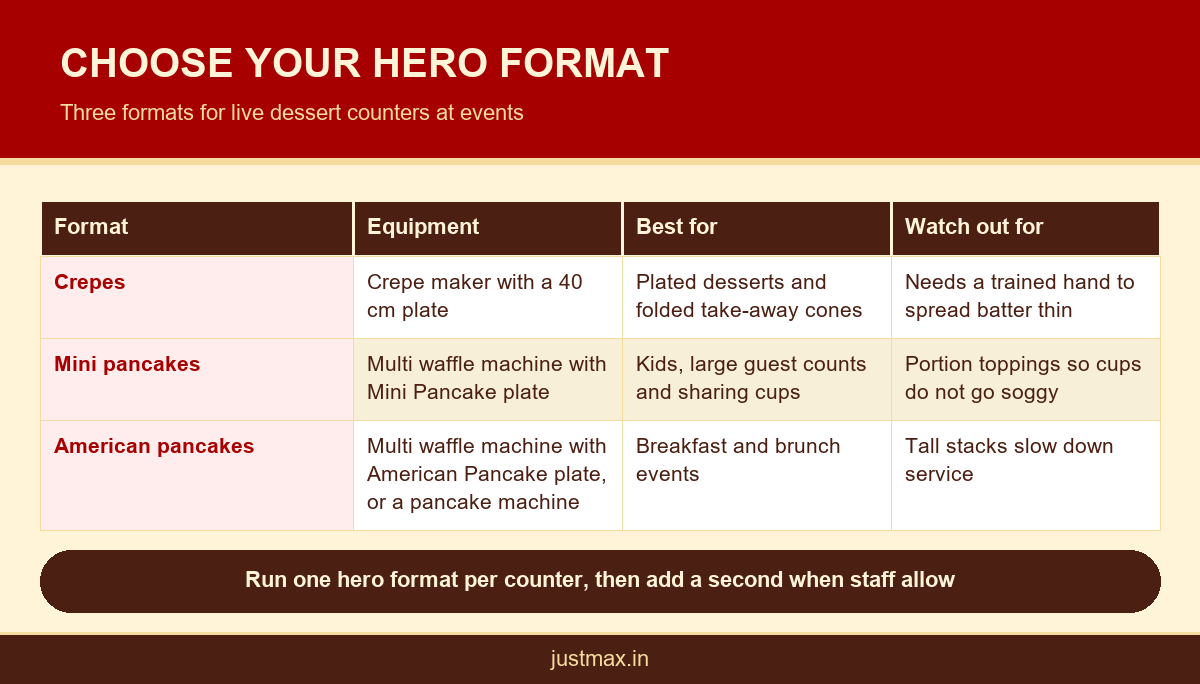
Choose one hero format for each counter. The comparison below shows the three formats caterers use most, with the equipment each one needs.

Comparison of crepe, mini pancake and American pancake formats for a live dessert counter

Mini pancake catering is especially useful for large guest counts. Bite sized pancakes cook in batches on a Mini Pancake plate fitted to a multi waffle machine, and they travel well in cups. Crepes look more theatrical and suit plated dessert service. American pancakes fit breakfast and brunch events best.

Build toppings in three tiers. Offer one classic, such as milk chocolate spread with banana. Add one premium choice, such as hazelnut or pistachio spread. Finish with one fresh option, such as seasonal fruit. Spreads that stay smooth at room temperature work well on a live dessert counter, because they spread without tearing a delicate crepe.

Fix portions before the event. Decide the exact scoop or spoon size for every topping and show it to the team. Consistent portions protect your margin and keep the last plate as generous as the first.

Plan serving ware with the menu. Crepes need plates or paper cones. Mini pancakes need cups and forks. Sharing boxes suit corporate events where guests eat while they talk. Order a little extra of everything, because live counters often attract repeat visits late in the evening.

Conclusion

A successful live pancake station comes down to preparation. Lay out the counter so guests move one way. Hold batter cold, mix in small batches and record times. Keep the menu short, with one hero format and toppings that hold well. Do this, and your counter becomes a highlight rather than a queue.

Planning live counters for the coming wedding season? Talk to the Just Max team about crepe makers, multi waffle machines, premixes and spreads. As a manufacturer since 2002, Just Max backs its equipment with life-long post-sales service.

Frequently Asked Questions

What equipment does a live pancake station need?

Most stations need one or two hot plates, such as a crepe maker or a multi waffle machine. Add chilled batter storage, a topping zone and sauce holding. A bottle warmer for sauces keeps chocolate and caramel pourable.

How many staff does a crepe station for events need?

Plan for at least one cook and one person handling toppings and hand-off. For larger events, add a runner to restock batter, spreads and plates. A timed dry run before the event confirms the right team size.

How long can pancake batter sit out at an event?

Treat batter as perishable food. WHO guidance advises against leaving perishable food at room temperature for more than two hours. Hold batter on ice, mix small batches and discard any batch that has been out too long.

Is mini pancake catering suitable for weddings?

Yes. Mini pancakes cook in batches, serve neatly in cups and suit guests of all ages. They work well for large receptions because portions are small, consistent and easy to hand over quickly, even during peak dessert time.

Which toppings work best on a live dessert counter?

Choose toppings that hold well at room temperature. Smooth chocolate, hazelnut and pistachio spreads from Just Max are easy to portion. Add one fresh option, such as seasonal fruit, and keep sauces warm in a dedicated holder.

Can I use a premix for crepes and pancakes at events?

Yes. A premix reduces the number of ingredients you handle at the venue and gives consistent results. Follow the mixing ratio on the pack, rest the batter as advised and keep mixed batter chilled throughout service.

How do I stop the queue at a live counter getting too long?

Keep the menu to four to six items and show the options clearly. Use a one-way guest path, prepare toppings in advance and separate the cook zone from the hand-off point so orders keep moving.

What power supply do live crepe and pancake counters need?

Check the venue supply before the event. Give each crepe maker or waffle machine its own outlet where possible, and avoid shared extension boards. Ask your equipment supplier for the exact power rating of each unit.

Where can I buy crepe makers and pancake premixes in India?

Just Max has manufactured crepe makers, multi waffle machines, bottle warmers, premixes and spreads in Kerala since 2002. Consumables can be ordered online, and equipment buyers receive life-long post-sales service from the Just Max team.

Categories
Blogs

How to Start a Dessert Catering Business in Kerala

A dessert catering business is one of the most practical food ventures you can start in Kerala today. Weddings, baptisms, housewarmings and office parties now expect a live dessert counter, not just a tray of payasam.

This guide covers the registrations you need, the commercial dessert equipment built in Kerala worth buying first, and a simple plan for your first 10 paid events. It is written for home bakers scaling up and new caterers who want to grow without wasting money.

Key Takeaways

  • Register your dessert catering business on the FSSAI FoSCoS portal before you take paid bookings. The registration or licence type depends on your scale and turnover.
  • Choose versatile catering startup equipment in Kerala, such as a multi waffle machine and bottle warmers, then add a chocolate fountain as bookings grow.
  • Treat your first 10 events as a structured learning phase for pricing, logistics and referrals.

Why Kerala Is Ready for a Dessert Catering Business

Kerala has a busy celebration calendar. Wedding season, Onam, Christmas and Eid each bring a wave of family functions and community events. Hosts increasingly want something guests will remember, and live dessert stations deliver exactly that.

Waffles made on the spot, a flowing chocolate fountain or crepes folded to order all create a moment. They also photograph well, which brings you free promotion on every guest’s phone.

The model suits home bakers who already sell cakes or brownies. You keep your kitchen skills and add equipment that turns them into an event service. It also suits existing caterers who want a premium add-on with better margins than standard buffet desserts.

Demand is not limited to the big cities. Towns across the state host large functions in auditoriums and parish halls, where a live dessert counter stands out from the usual spread.

Local supply is another advantage. Just Max has manufactured dessert equipment in Mavelikara since 2002, so spares, servicing and advice are close at hand rather than a long courier ride away.

Licences and Registrations You Need Before the First Booking

Getting registered early protects your new venture and builds trust with clients. Corporate clients and auditorium managers often ask for your food safety number before they confirm a booking.

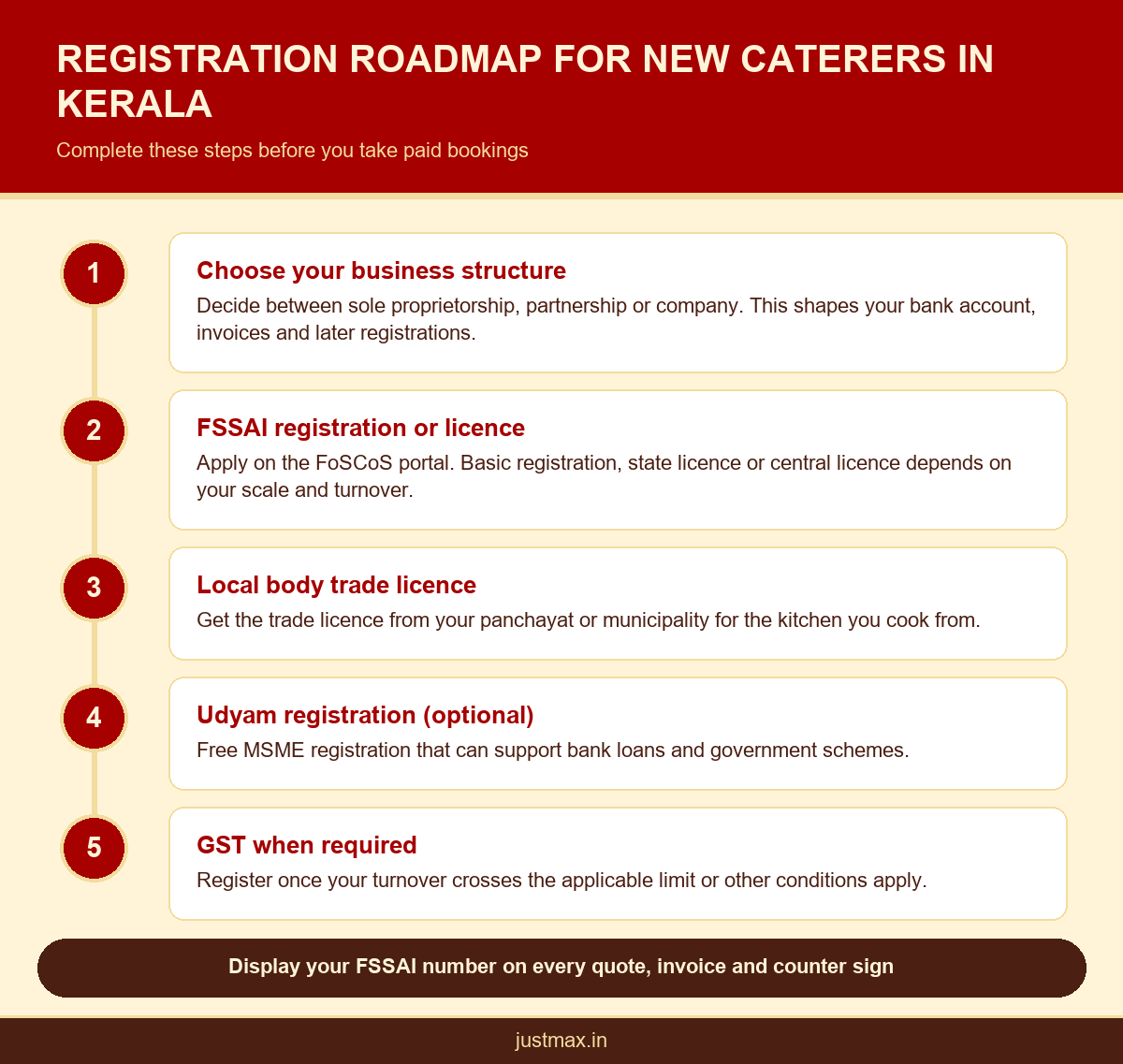
Here is the usual sequence for a new caterer in Kerala:

  • FSSAI registration or licence: Every food business needs one. Apply online through the FSSAI FoSCoS portal. Small operators usually start with basic registration, while larger businesses need a state or central licence. Check the current criteria on the portal before you apply.
  • Local body trade licence: Your panchayat or municipality issues the trade licence for food businesses in its area. Ask the local office which documents they need for a home or commercial kitchen.
  • Udyam registration: This free, optional registration on the government Udyam portal records you as a micro enterprise. It can help with bank loans and some government schemes.
  • GST registration: GST becomes mandatory once your turnover crosses the limit for your category, or in certain other cases. Many small caterers register as they grow. Confirm the current rules with a tax consultant.

Infographic showing the registration steps for a new dessert catering business in Kerala, from FSSAI registration to GST

Keep copies of every certificate in a folder and on your phone. When a client asks whether you hold an FSSAI licence for caterers, you can answer with confidence. Display your number on quotes, invoices and counter signage. It is a simple signal that you take hygiene seriously.

Catering Startup Equipment for Kerala: What to Buy First

Buy equipment that serves several menus at once. Your first purchases should earn money at almost every type of event, from a 50 guest birthday to a 300 guest wedding.

A multi waffle machine is the most flexible starting point. Interchangeable plates let you switch between Belgian waffles, waffle sticks, mini pancakes and even burger buns. One machine covers both sweet and savoury requests.

Pair it with bottle warmers for sauces and spreads. They keep chocolate, caramel and spread toppings pourable through a long service. Ready waffle and pancake premixes save prep time and keep every batch consistent. That matters when you are cooking in an unfamiliar hall.

A chocolate fountain is the natural second step. It is the centrepiece most wedding clients ask about, and it lifts the value of your package.

Equipment Why it matters When to buy
Multi waffle machine Most flexible menu, with sweet and savoury plates Before your first event
Bottle warmers Keeps sauces and spreads ready to pour Before your first event
Waffle and pancake premix Consistent batter and faster prep at venues Before your first event
Chocolate fountain Wedding centrepiece for premium packages After 3 to 5 events
Crepe maker or dipping station Adds variety for larger functions Once repeat bookings arrive

For smaller items such as dispensers, plates and serving tools, use our catering equipment checklist. Always check the power needs of every machine against the venue supply before you quote.

Ask each venue how many sockets sit near the dessert counter and whether a dedicated line is available for heating equipment. Some machines, such as a commercial churros machine, need a three phase supply. If a hall relies on a generator, confirm its capacity well before the event day.

Menus and Consumables That Keep Clients Coming Back

Equipment gets you booked once. A well planned menu gets you booked again. Keep your core menu short so service stays fast, then add premium choices that raise the value of each package.

A strong starter menu has three parts. First, a base of waffles or pancakes made from a reliable premix such as vanilla, chocolate (brownie) or red velvet. Second, two or three warm spreads served from bottle warmers. Third, a finishing touch such as fruit, nuts or sprinkles.

Match the menu to the occasion:

  • Kids birthdays: waffle sticks or mini pancakes with milk chocolate and cookie spread.
  • Weddings: Belgian waffles, a chocolate fountain with fruit dippers, and a pistachio or hazelnut option for a premium feel.
  • Corporate events: quick serve waffles in two flavours with a choice of toppings, served in neat portions.
  • Church and community functions: high volume pancakes with simple chocolate and white chocolate toppings.

Calculate consumables per event before you quote. Track how much premix and spread each function actually uses, then build that into your price per head. After a few events, you will know your numbers well enough to quote larger functions with confidence.

Hygiene matters as much as taste. Keep spreads covered, use a clean serving tool for each topping and store premix in sealed containers. Guests notice a tidy counter, and so do the hosts who recommend you to their friends.

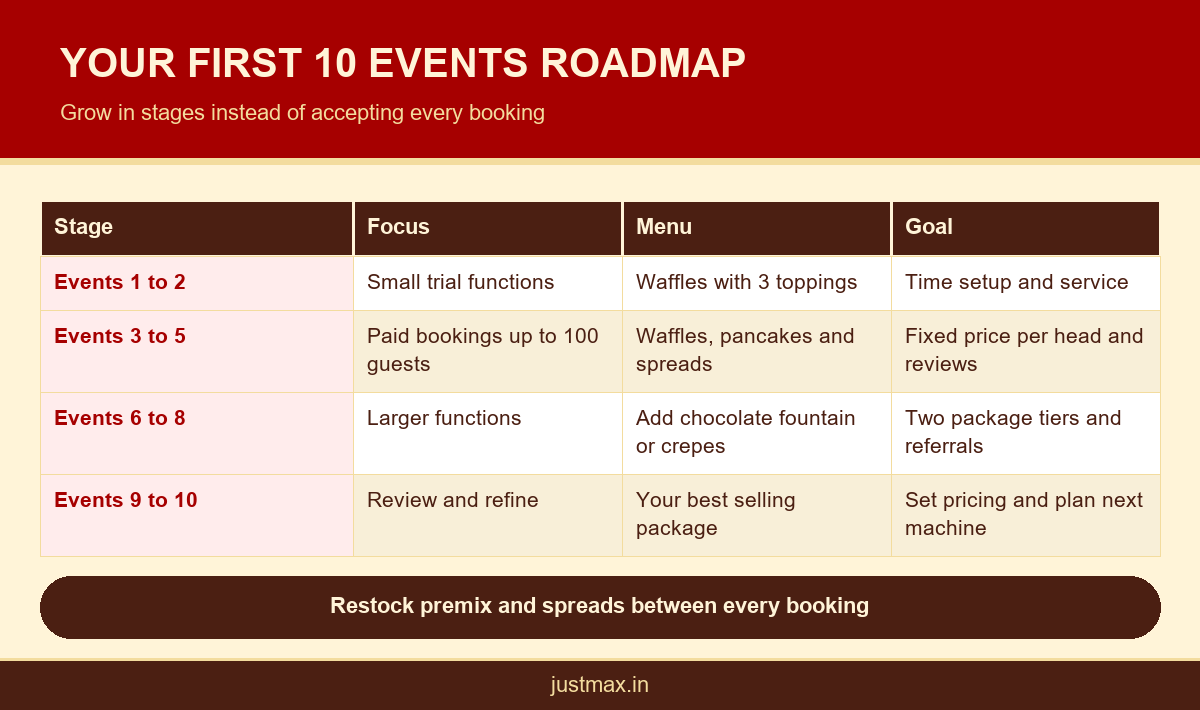
Your First 10 Events: A Practical Roadmap

Your first 10 events teach you what to charge, how long setup takes and which items guests love. Plan them in stages rather than accepting every booking that comes your way.

Events 1 and 2: Start with friends, family or a small community function. Keep the menu to waffles with three toppings. Time your setup, service and pack down, and note every item you forgot.

Events 3 to 5: Take paid bookings of up to about 100 guests. Build a fixed price per head and a written checklist. Ask every host for photos and a review.

Events 6 to 8: Add a chocolate fountain or crepes and offer two package tiers. Approach auditoriums, wedding planners and photographers who can refer you.

Events 9 and 10: Review your numbers. Which package sold best, and which items wasted stock? Use the answers to set your pricing and plan your next equipment purchase.

Infographic table showing a dessert catering business roadmap for the first 10 events, with focus, menu and goal for each stage

Throughout, keep consumables topped up. Running out of premix or spread halfway through a wedding is the fastest way to lose a referral. Ordering online from a manufacturer lets you restock between bookings without long waits.

Conclusion

Starting a dessert catering business in Kerala comes down to three steps in order: the right registrations, a small set of versatile equipment and a disciplined plan for your first events. Get those right and referrals will follow, because live desserts are memorable. For advice on machines that suit your budget and event size, speak with the Just Max team or message us on WhatsApp at +91 88480 43729. Every machine comes with life-long post-sales service.

Frequently Asked Questions

How much money do I need to start a dessert catering business in Kerala?

Costs depend on your menu and equipment. Many caterers start with one multi waffle machine, bottle warmers and premix stock, then add a chocolate fountain later. Contact a manufacturer for current equipment prices before planning your budget.

Do I need an FSSAI licence for home based dessert catering?

Yes. Every food business in India, including home kitchens, needs FSSAI registration or a licence. Small operators usually qualify for basic registration. Apply online through the FoSCoS portal and display your number on invoices and counters.

Is dessert catering profitable in India?

Live dessert counters often command a premium over standard buffet desserts because guests see food made fresh. Profit depends on your pricing per head, consumable costs and how many events you book each month.

What is the best first machine for dessert catering?

A multi waffle machine is a strong first choice. Interchangeable plates cover Belgian waffles, waffle sticks, mini pancakes and burger buns, so one machine handles birthdays, weddings and corporate events. Pair it with ready premix for faster prep.

Which toppings and spreads work best at events?

Chocolate, hazelnut and white chocolate are crowd favourites, with pistachio and cookie flavours adding a premium touch. Browse the Just Max spreads range and keep them warm in bottle warmers for smooth pouring during long services.

Do I need GST registration to start catering?

Not always at the start. GST registration becomes mandatory once turnover crosses the limit for your category, or in certain other cases. Check the current rules on the GST portal or with a tax consultant before you grow.

How should I price my first catering events?

Build a price per head that covers consumables, travel, staff time and equipment wear, then add your margin. Track actual costs at your first few events and adjust. Offer two package tiers to make choosing easy.

Where can I get service for dessert equipment in Kerala?

Just Max manufactures dessert equipment at its Mavelikara factory and has an office in Kakkanad. Every machine includes life-long post-sales service. Discover the Just Max story since 2002 and the support available to caterers across Kerala.

How many staff does a small dessert catering setup need?

One person can run a single waffle counter for a small function. For larger events, plan one person per live station plus a helper for restocking, plating and cleaning, so the queue keeps moving throughout the event.

Categories
Blogs

Corporate Event Dessert Catering for 200 Guests: The Plan

Corporate event dessert catering has moved well beyond a tray of pastries at the back of the hall. Office teams now expect a live counter, fresh waffles from a commercial multi waffle machine and a chocolate fountain that pulls people together. This guide gives you a worked plan for 200 guests. You will see the menu, the corporate catering equipment list, the staffing and a simple timeline. Whether you run a catering business or book caterers for your office, the plan helps you scope the counter, avoid long queues and keep service smooth from the first plate to the last.

Key Takeaways

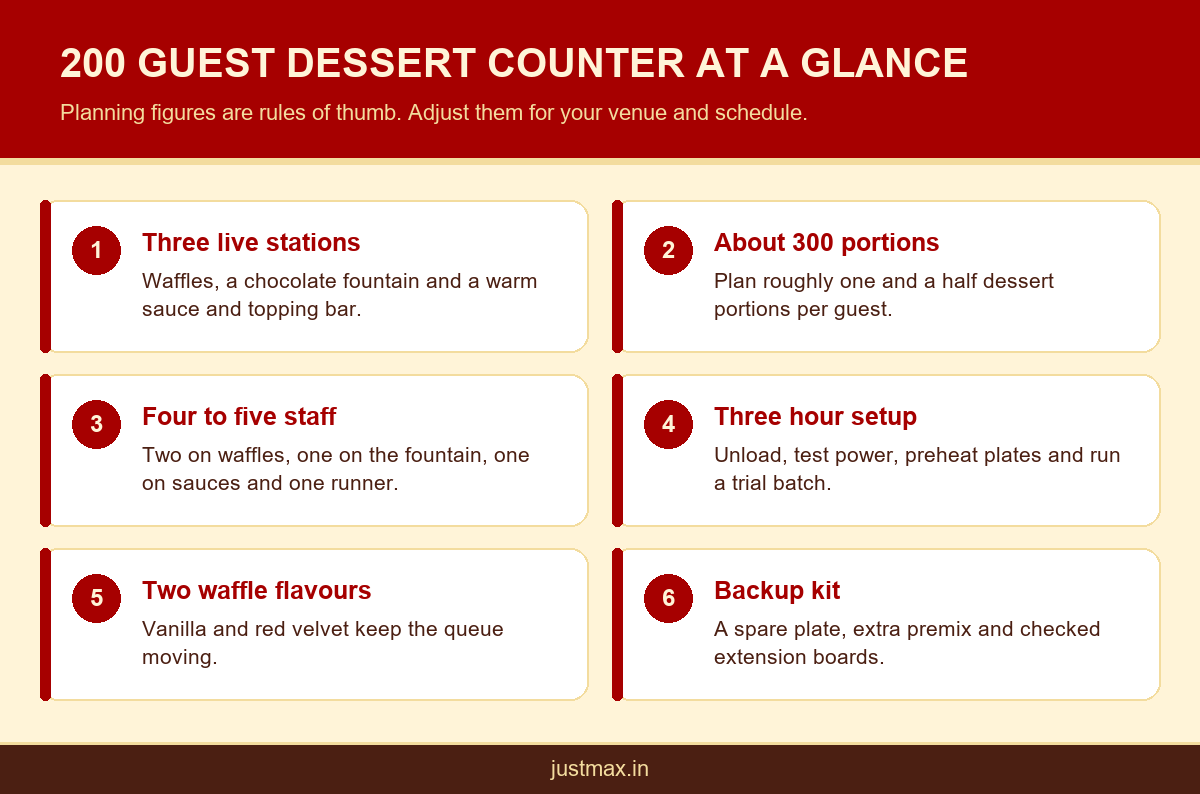
  • A 200 guest office event runs well on three live stations: waffles, a chocolate fountain and a sauce and topping bar.
  • Plan around 300 dessert portions as a rule of thumb, with four to five trained staff on the counter.
  • Test every machine and run a trial batch a week before the event, then allow three hours for setup on the day.

Why Live Dessert Counters Work at Corporate Events

A live counter turns dessert into a moment. Guests watch waffles come off the plate and chocolate flow over the tiers. That sense of theatre works well at annual days, product launches, townhalls and client meets.

It also solves a practical problem. Plated desserts need serving staff at every table. A live counter lets guests come to you, so a small team can serve a large crowd. For event planners, it gives the brief a clear focal point that photographs well and keeps people talking. In event management, a natural gathering spot like this is hard to design any other way.

There is a wellbeing angle as well. A short dessert break between sessions gives attendees a reason to step away from their screens. It also helps colleagues from different teams meet in a relaxed setting. HR teams can plan these moments on purpose, rather than leaving them to chance.

For caterers, the counter is also a margin opportunity. Premixes and spreads keep the cost per portion predictable. The same corporate catering equipment can then be redeployed across weddings, launches and festive events through the year, so each machine earns its place on more than one booking.

Building the Menu for a Dessert Counter for Office Events

Corporate guests eat on the move. Many will have a lanyard in one hand and a phone in the other. Choose desserts that are easy to hold, quick to serve and familiar enough for a mixed crowd. A dessert counter for office events should feel generous, yet never slow.

  • Live waffle counter: classic vanilla and red velvet waffles made from Belgian waffle and pancake premixes, served on a stick or in a paper boat for easy eating.
  • Chocolate fountain station: fruit, marshmallows and biscuits for dipping. A fountain draws a crowd and needs very little plating.
  • Sauce and topping bar: warm milk chocolate, hazelnut and white chocolate drizzles from ready to use chocolate spreads, plus sprinkles and chopped nuts.

Keep the menu to two waffle flavours and three sauces. More choice slows the line without adding much delight. A heart or stick waffle plate adds a playful touch for theme days, and it keeps every portion even. A live waffle counter for events also gives guests something to watch while they wait.

Ask about branding too. Some clients like toppings in company colours or a seasonal waffle plate for Diwali and Christmas parties. Small touches like these make the counter feel planned for that event, not copied from the last one.

Check dietary needs early. Ask the HR or admin team how many guests avoid eggs, nuts or dairy. Then plan a clearly labelled option for each group, and label every sauce at the counter too.

Corporate Event Dessert Catering Equipment List for 200 Guests

The table below maps each station to the equipment, consumables and team it needs. Treat the staff numbers as a starting rule of thumb. Adjust them for your venue layout and the length of the service window.

Station Equipment Consumables Staff
Live waffle counter Multi Waffle Machine (Premium) or Double Multi Waffle, with Heart or Stick waffle plates Vanilla and Red Velvet premix, paper boats, sticks 2
Chocolate fountain station A standard chocolate fountain sized for the crowd Fountain chocolate, fruit, marshmallows, skewers 1
Sauce and topping bar Triple or quad sauce bottle warmer Milk Choco, Hazelnut and White Choco spreads, toppings 1
Support Spare waffle plate, extension boards checked by the venue electrician, handwash point Extra premix pack, wipes, bins 1 runner

Power is the item planners forget most often. Confirm the power needs of every machine with your supplier and share them with the venue. Ask for dedicated sockets for the waffle machines and fountain, away from the sound and lighting setup.

Plan the layout as well. Each live station needs a sturdy table, room behind it for the operator and a clear path for the runner. Keep the fountain away from air conditioning vents, which can cool the chocolate and break the flow.

Food safety matters just as much as speed. Keep hot holding, clean utensils and handwashing in place, and follow the basics in the WHO guidance on food safety. Your catering business should also hold valid FSSAI registration before you take the booking.

Infographic summarising stations, portions and staff for corporate event dessert catering at 200 guests

Staffing and Timeline for Service Day

A 200 guest counter usually runs well with four to five people. As a rule of thumb, plan two on waffles, one on the fountain, one on the sauce bar and one runner who restocks and clears. Brief everyone on the menu, the allergen labels and who answers guest questions.

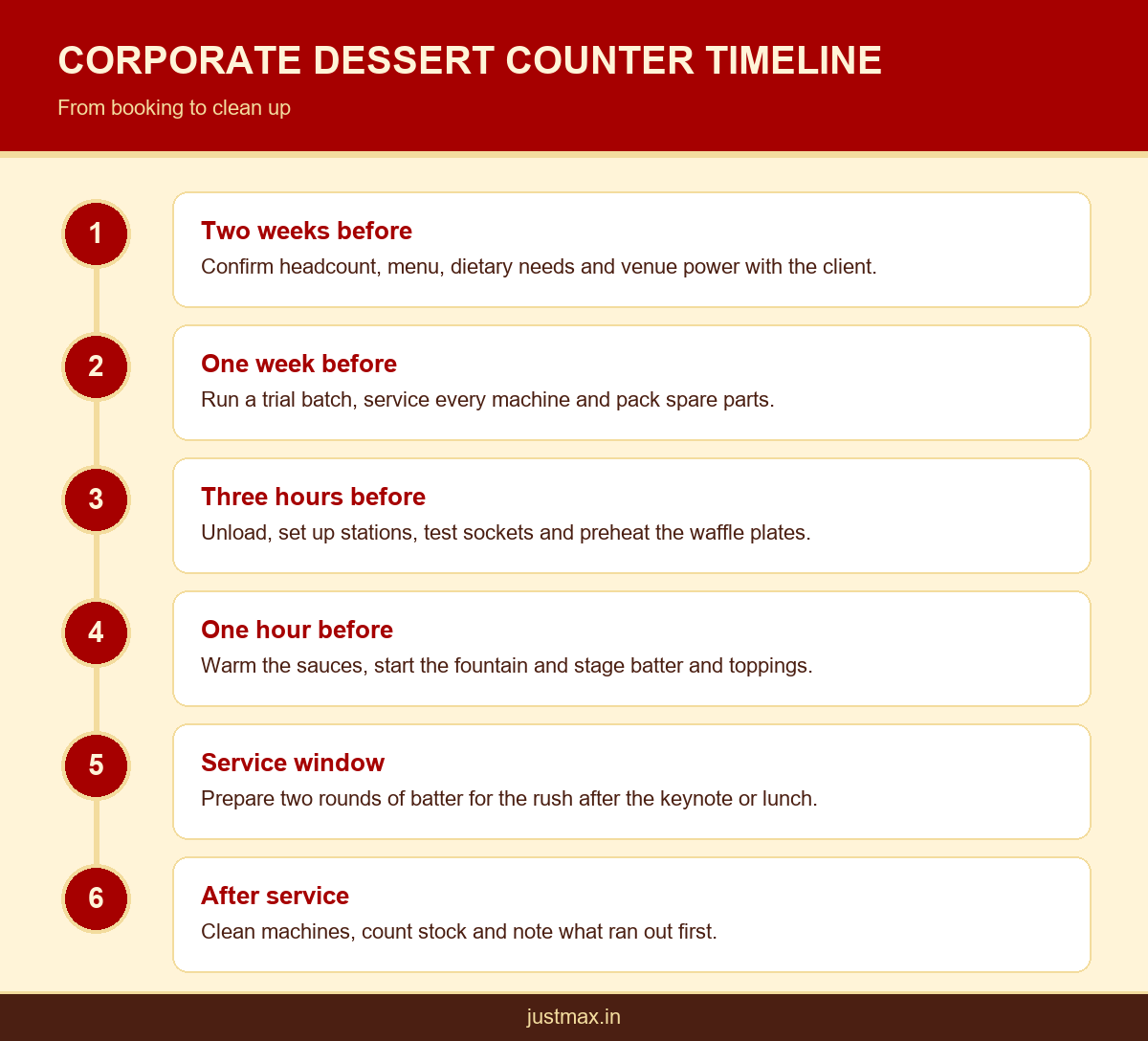
Good mise en place makes the day calm. Batter, toppings, skewers and spare stock should sit within reach before the first guest arrives. Use the timeline below to keep every task on track.

Infographic timeline for setting up a live waffle counter for events and a chocolate fountain station

Expect the biggest queue right after the keynote or the lunch break. Have batter ready for two full rounds on the waffle machines before that moment. Keep the fountain topped up and the warm sauces at the right consistency, so the line keeps moving.

Set up the counter so the queue flows one way. Place plates and napkins at the start, the waffle station in the middle and the sauce bar at the end. Guests then collect, top and move away without crossing paths. A small menu sign helps people decide before they reach the front.

When service ends, clean each machine as per its manual. Count leftover stock and note what ran out first. Those notes make your next quote sharper and your next counter even smoother.

How to Quote and Brief the Client

A clear quote prevents last minute surprises for both sides. Break your price into three parts: equipment and setup, consumables per portion, and staff hours. The client can then see exactly what changes if the headcount moves.

Ask the client five questions before you price the job:

  • The final headcount and how many guests are likely to visit the counter.
  • The event type and service window, such as a two hour launch or a full day conference.
  • Venue access times, loading points and the power available near the counter.
  • Dietary needs and any branding requests, like themed toppings or company colours.
  • Who on their side signs off the menu and confirms changes.

Send back a one page brief with the menu, station layout, team size and timeline. Once the client approves it, lock the headcount a few days before the event. That gives you time to order premixes and spreads in the right quantity, without overstocking.

Conclusion

Corporate event dessert catering for 200 guests comes down to three things. Pick a short, easy to eat menu. Match each station to the right equipment and team. Then rehearse the timeline so the rush feels relaxed. Just Max has manufactured dessert equipment in Kerala since 2002 and backs every machine with life-long post-sales service. We can help you choose machines, plates and consumables that suit your usual event size. To plan your counter, talk to the Just Max team or message us on WhatsApp at +91 88480 43729.

Frequently Asked Questions

How many dessert portions should I plan for corporate event dessert catering?

As a rule of thumb, plan about one and a half portions per guest, so roughly 300 portions for 200 people. Plan more for long events, evening slots or menus where dessert replaces a full meal.

What corporate catering equipment do I need for a live dessert counter?

Most counters need a commercial waffle machine, a chocolate fountain and a bottle warmer for sauces. A compact dipping station is a useful add on for smaller venues where a full fountain feels too large.

How many staff does a dessert counter for office events need?

For 200 guests, four to five people usually works. Plan two on the waffle station, one on the fountain, one on the sauce bar and one runner who restocks, clears and manages the queue at peak moments.

How early should caterers set up a live waffle counter for events?

Allow about three hours before service. That covers unloading, power checks, preheating waffle plates, warming sauces and a test batch. Larger venues or tight loading windows may need more time, so confirm access with the venue early.

Which waffle flavours work best for corporate guests?

Classic vanilla and red velvet suit most mixed crowds. Vanilla pairs with every sauce, while red velvet adds colour and a premium feel. Two flavours keep the line moving without making guests pause too long over choices.

Can a chocolate fountain work indoors at an office venue?

Yes. A fountain works well indoors on a stable, level table placed away from air conditioning vents and foot traffic. Lay a protective cloth underneath and keep a staff member nearby to manage dipping and top ups.

How do I keep dessert sauces warm during a long event?

Use a bottle warmer that holds squeeze bottles at a steady serving temperature. A triple or quad model covers three or four sauces. Refill bottles from spare stock rather than reheating them repeatedly in a microwave.

What should a dessert catering checklist include?

List every machine, plate, cable, consumable and serving item, then tick them off at loading and again at setup. This equipment checklist for caterers is a good starting template to adapt for your own events.

Do caterers need an FSSAI licence for corporate events?

Food businesses in India, including caterers, need FSSAI registration or a licence based on their scale. Event clients often ask to see it, so keep a copy ready along with your hygiene and staff health records.

Categories
Blogs

Outdoor Dessert Catering in Summer: Heat, Power and Chocolate

Outdoor dessert catering looks effortless when everything goes right. Guests see a flowing chocolate fountain, warm waffles and glossy sauces under fairy lights. Behind that scene, caterers manage heat, humidity, dust, wind and uncertain power. One hour of afternoon sun can thicken chocolate, soften spreads and trip an overloaded generator. This guide shows you how to plan the site, size your power, handle chocolate and keep food safe in the open. It also explains how to choose equipment from the Just Max chocolate fountain range for open air events.

Key Takeaways

  • Successful outdoor dessert catering starts with a site visit, a load list and a dedicated generator for catering equipment that you never share with lighting or sound.
  • Shade, wind cover and timing protect chocolate far better than extra heat. A chocolate fountain outdoor needs a sheltered, level and stable base.
  • A dessert setup in hot weather depends on food safety discipline: covered dippers, clean utensils, safe water and short holding times.

Plan the Site First for Outdoor Dessert Catering

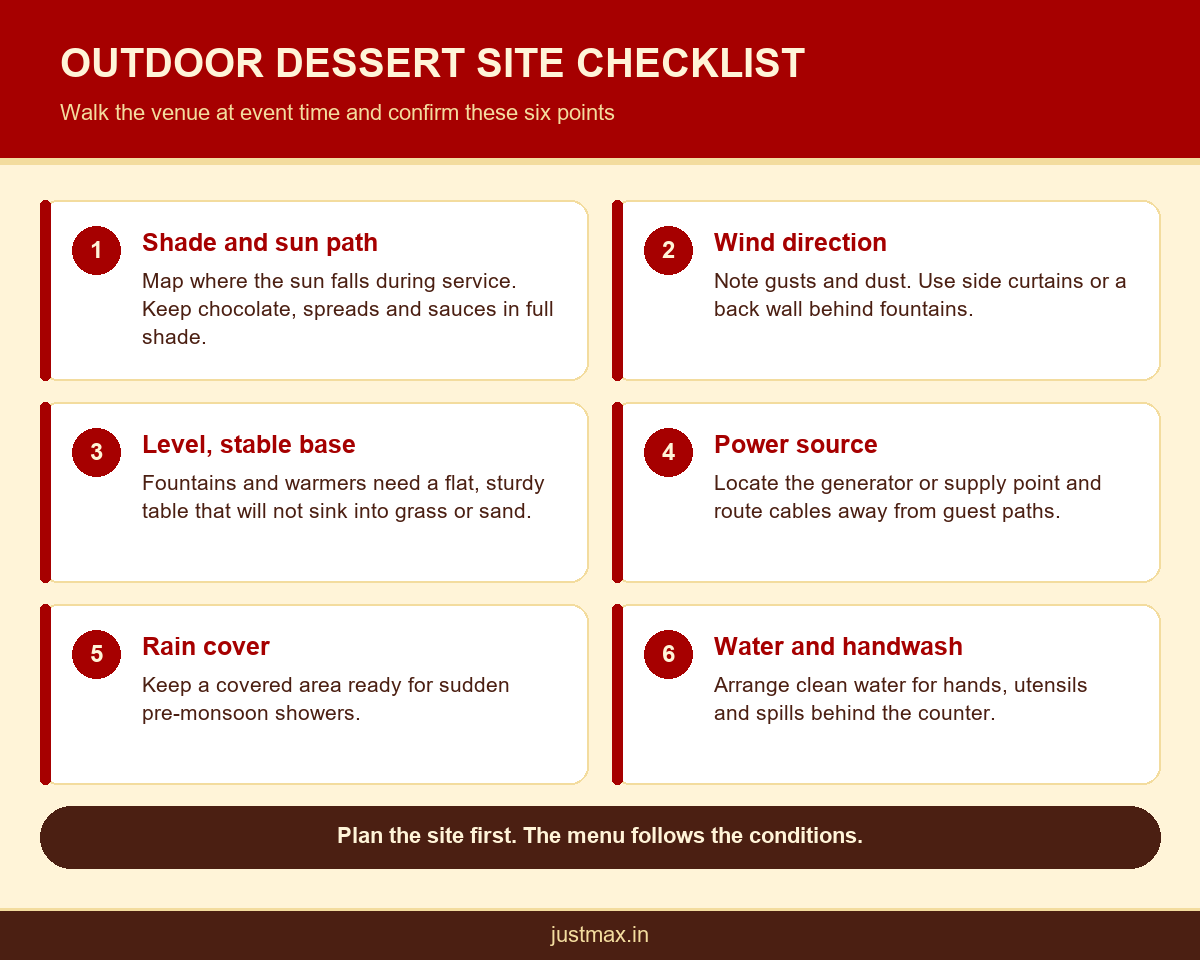
Every outdoor venue behaves differently. A beach lawn in Kovalam, a rooftop in Kochi and a farmhouse near Bengaluru each bring their own wind, sun angle and dust. Visit the site at the same time of day as the event. Note where the sun falls, where the wind comes from and where the power point sits. Ask the venue where guests will queue, because dessert counters attract crowds quickly.

Check the forecast from the India Meteorological Department a week before the event and again the day before. Pre-monsoon showers and sudden gusts are common between April and June in many parts of India. Build a fallback for each risk. Keep a covered area ready for rain, side curtains for wind and a tented spot if the sun moves faster than expected. A simple checklist keeps the whole team aligned.

Outdoor dessert catering site checklist covering shade, wind, level base, power, rain cover and handwash water

Think about guest flow as well. Outdoor guests tend to arrive in waves after the main course, and a single narrow counter creates long queues in the sun. Split stations where you can. Put the chocolate fountain in one shaded spot and the waffle or crepe counter in another. Two shorter queues feel faster, and staff stay calmer.

Share the final layout with the event planner and the venue manager. Mark the dessert zone, the generator position, the cable route and the handwash point on one sketch. Clear agreement before the day saves arguments when the crowd arrives.

Power Planning: Choosing a Generator for Catering Equipment

Power is where most outdoor dessert counters fail. Heating equipment draws steady current for hours. Chocolate fountains, bottle warmers, waffle machines and crepe makers all need a reliable supply. When lighting, sound systems and air coolers share the same line, voltage drops and breakers trip in the middle of service.

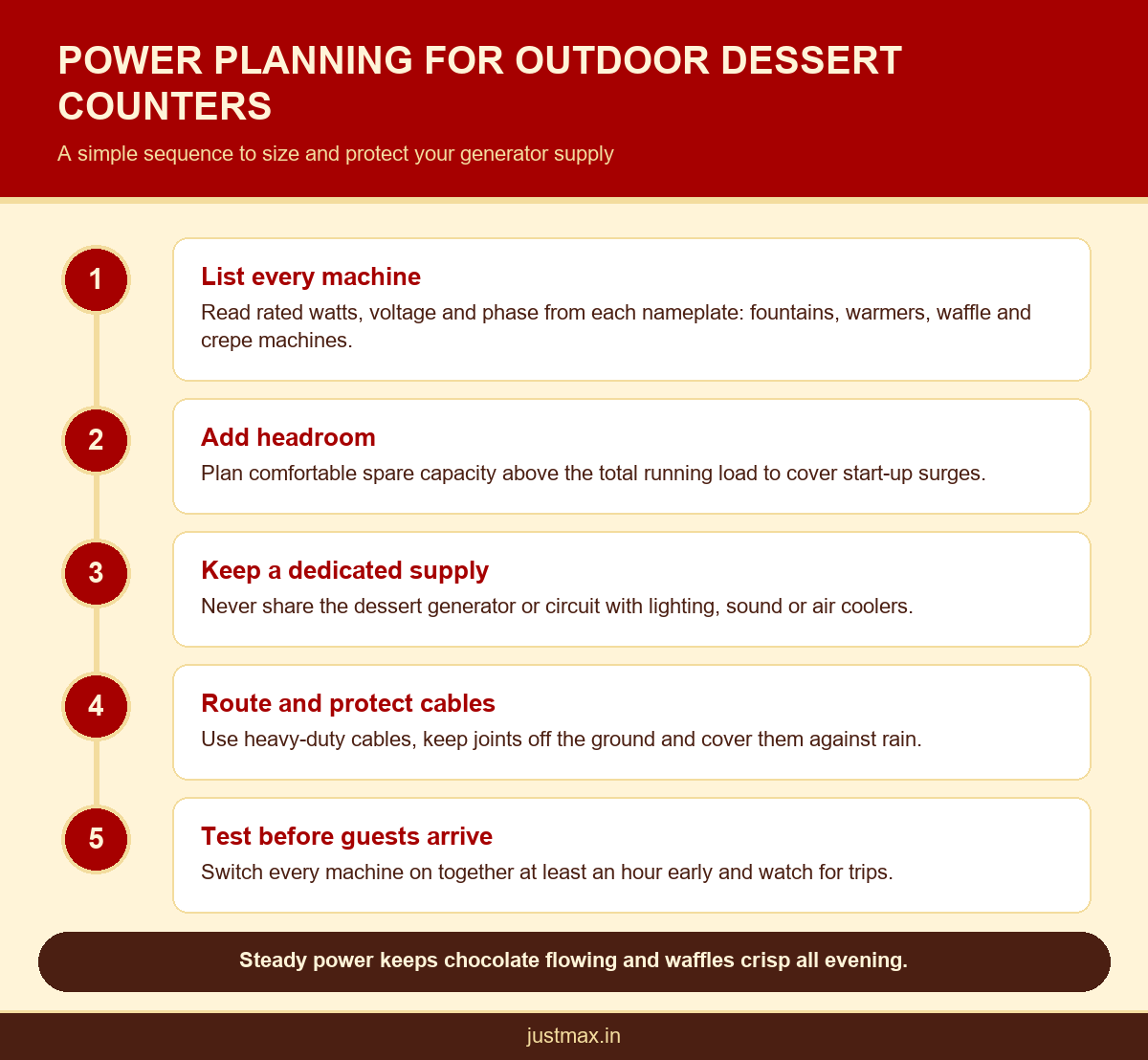
Ask for a dedicated generator for catering equipment, kept separate from lighting and music. Add up the rated wattage printed on each machine’s nameplate, then leave generous headroom for start-up surges. Check voltage and phase as well. Some commercial machines, such as the Just Max churros machine, run on three-phase supply, so confirm the generator offers it before you book.

Power planning steps for choosing a generator for catering equipment at outdoor dessert events

Use heavy-duty extension cables of the right gauge and keep every connection off the ground. Cover joints against rain and route cables behind the counter, away from guest paths. Label each plug so staff can isolate one machine quickly if something goes wrong. Run a full power test with every machine switched on at least an hour before guests arrive.

Plan fuel and placement too. Order enough fuel for setup, the full service window and breakdown, with a reserve on site. Place the generator downwind and well away from the food area, so exhaust fumes and noise never reach the counter. Ask the generator vendor to keep an operator on duty. A quick restart matters far more than a perfect spreadsheet.

Handling a Chocolate Fountain Outdoor in Heat and Wind

Chocolate is the most sensitive item on any outdoor menu. Direct sun warms the tiers unevenly. Wind pushes the chocolate curtain sideways, breaks the flow and blows dust onto the surface. High humidity can leave chocolate looking dull on fruit and marshmallows. None of these problems are solved by turning up the heat.

Treat a chocolate fountain outdoor as a sheltered station. Place it in full shade with a back wall or side curtain facing the wind. Keep the base perfectly level so the curtain falls evenly. Use chocolate made for fountains and follow its preparation guidance. For a wedding lawn, a tiered Standard or Cascade fountain makes a strong centrepiece. For tighter or windier spots, a compact model keeps the chocolate closer to the base.

Sauces and spreads behave better in covered bottle warmers than in open bowls. Warmers keep portions consistent, protect sauces from insects and dust, and speed up service at busy counters. Prepare dippers in a cool area and bring them out in small batches. After the event, clean the fountain the same night, because heat and dust make residue harder to remove. Our chocolate fountain cleaning routine walks through each step.

Food Safety for a Dessert Setup in Hot Weather

Heat speeds up spoilage, so a dessert setup in hot weather needs tighter habits than an indoor buffet. The World Health Organization’s food safety guidance sets out five keys: keep clean, separate raw and cooked food, cook thoroughly, keep food at safe temperatures, and use safe water and raw materials. Each key applies directly to an open air dessert station.

  • Cut fruit in small batches and keep it covered in a cool box until service.
  • Serve dippers with skewers or tongs. Guests and staff should never handle them directly.
  • Keep waffle and crepe batter chilled in insulated containers and pour only what you need.
  • Set up a handwash point with clean water, soap and paper towels behind the counter.
  • Wipe counters and change cloths often, because dust settles fast outdoors.

Batter stations need the same care. Premixed batter for multi waffle machines is easy to portion, which helps you avoid large open containers in the heat. Look after your team as well. Staff working beside hot plates in summer need caps, regular water breaks and shifts that rotate away from the hottest station. A rested team serves faster and makes fewer mistakes.

Choosing Equipment That Suits Open Air Events

Not every machine suits every venue. Outdoor work rewards equipment that is sturdy, easy to clean and quick to set up. Before you finalise the menu, match each station to the guest count, the space and the power you can secure. A smaller menu served well beats a long menu that struggles in the heat.

  • Choose a fountain size that fits the shaded area you actually have, not the largest model available.
  • Pick bottle warmers by the number of sauces on the menu. Single, Double, Triple and Quad options cover most counters.
  • For long dessert queues, a Double Multi Waffle machine keeps output steady during the post dinner rush.
  • Favour stainless steel surfaces and removable parts that you can wash thoroughly the same night.

Support matters as much as the machine. Summer is peak season for weddings and parties in many cities, and a breakdown in May costs more than the repair itself. Work with a manufacturer that offers spares and service when you need them, so one fault never cancels a booking.

Conclusion

Outdoor dessert catering rewards caterers who plan for the weather, not just the menu. Walk the site, give your machines a dedicated power supply and keep chocolate and sauces in shade. Hold food for short periods and keep every station clean. With the right equipment and a clear plan, summer events can become your most talked about work. Just Max has manufactured dessert equipment in Kerala since 2002 and backs every machine with life-long post-sales service. Speak to the Just Max team to plan your next open air dessert counter.

Frequently Asked Questions

What equipment do I need for outdoor dessert catering?

Most outdoor dessert counters use a chocolate fountain, bottle warmers for sauces, a waffle or crepe machine and a Just Max dipping station. Add shade, wind cover, a level table, a dedicated generator and clean water for handwashing.

How do I keep a chocolate fountain working outdoors in summer?

Place the fountain in full shade with wind cover behind it. Use chocolate made for fountains, follow its preparation guidance and keep the base level. Bring dippers out in small batches and watch the chocolate flow closely during service.

What size generator do I need for catering equipment?

Add the rated wattage from every machine’s nameplate, then plan comfortable headroom for start-up surges. Keep dessert equipment on its own generator or circuit, separate from lighting and sound, and confirm voltage and phase needs in advance.

Can I set up a dessert station on a beach or lawn?

Yes, with preparation. Use sturdy, level tables that will not sink, shield equipment from sand and wind, and keep cables off the ground. Avoid direct sun on chocolate and plan a covered fallback area for sudden showers.

How long can dippers stay out at a hot outdoor event?

Keep holding times short. Put out small batches and replace them often instead of filling large trays. Keep cut fruit covered, serve with tongs or skewers, and follow WHO guidance on keeping food at safe temperatures throughout service.

Which chocolate works best for an outdoor fountain?

Choose chocolate made for fountain flow rather than standard baking chocolate. Our guide to liquid chocolate for fountains explains what to look for, including flow, flavour and how much to order for each event size.

How do I protect sauces and spreads from heat and insects?

Serve sauces from covered squeeze bottles held in bottle warmers instead of open bowls. This keeps portions consistent, limits exposure to dust and insects, and speeds up service. Store unopened jars in a cool, shaded area until needed.

When should I check the weather before an outdoor event?

Check the IMD forecast about a week before the event and again the day before. Pre-monsoon showers and strong gusts are common in summer. Confirm rain cover, side curtains and a backup layout with the venue well in advance.

DEALERSHIP ENQUIRY