Professional Catering Equipment for Hotel Banquet Dessert Sections
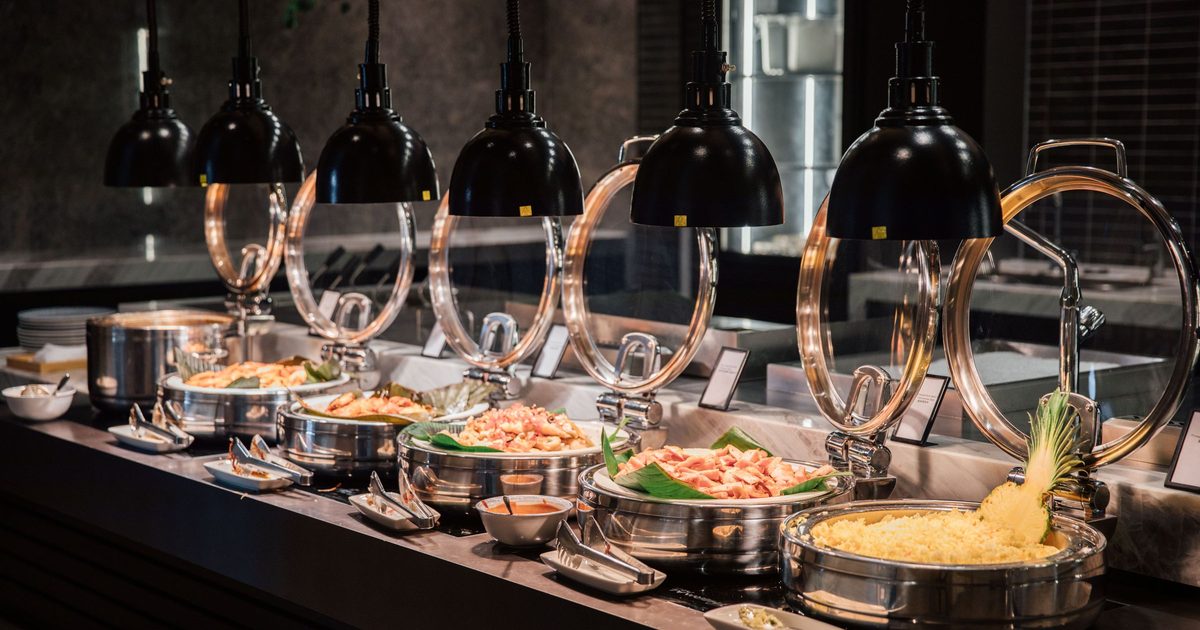
Choosing professional catering equipment for a hotel banquet dessert section is a different job from equipping a cafe counter. Banquets bring sudden peaks, long service windows and guests who expect every station to look perfect from the first plate to the last. Yet many purchase teams still buy dessert machines one at a time, with no common standard. This guide gives F&B managers, banquet managers and purchase teams a practical spec sheet. It covers capacity, power, footprint, hygiene and after sales support, so you know exactly what to ask any supplier of dessert service appliances.
Key Takeaways
- Write one spec sheet for the whole dessert section before you compare brands, so every machine fits the same power, space and hygiene plan.
- Ask suppliers for rated capacity, power draw, footprint and cleaning steps in writing. Do not rely on brochure photos.
- Treat service, spares and staff training as part of every hotel banquet dessert equipment purchase, not an afterthought.
Why Professional Catering Equipment Needs a Dessert Spec Sheet
A banquet dessert section runs on a fixed clock. Guests arrive at the counter in waves, usually right after the main course. A station that cannot keep up creates queues, and queues are what guests remember. That is why buffet dessert equipment should be specified for the peak, not the average.
Most hotels already hold detailed specs for the hot kitchen line. The dessert section often grows piece by piece instead, as menus change or a wedding client asks for something new. The result is a mix of machines with different plugs, cleaning routines and service contacts. A single spec sheet fixes that. It lets the purchase team compare suppliers on the same terms. It also gives the banquet team equipment that works together on the night.
A spec sheet also protects the hotel when teams change. New banquet managers inherit a clear record of what each station needs. Purchase teams can reorder like for like without starting from scratch.
If you are still deciding whether to own or hire a fountain, our guide to renting versus buying a chocolate fountain covers that choice in detail. The rest of this article focuses on what to specify once you decide to buy.
Capacity and Throughput: Questions to Ask Before You Buy
Capacity is where most specs go wrong. A machine can look generous on paper and still slow a busy banquet. Ask every supplier for rated figures in writing. Then test them against your largest regular event.
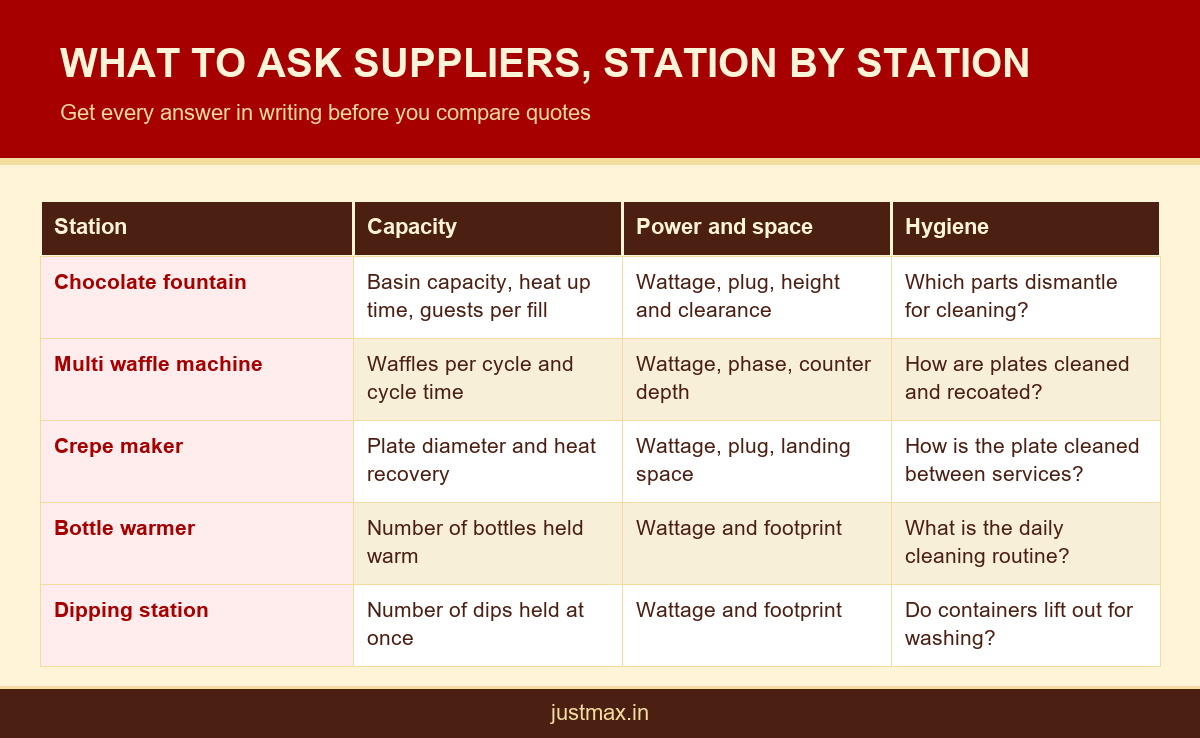
- Chocolate fountains: How much chocolate does the basin hold? How long does it take to reach serving temperature? How many guests does the supplier recommend per fill?
- Waffle machines: How many waffles come off each cycle, and how long is each cycle? Compare plate options on multi waffle machines against your menu.
- Crepe makers: What is the plate diameter, and how quickly does the plate recover heat between crepes?
- Holding equipment: How many sauce bottles or containers can stay warm at once?
- Dipping stations: How many dips can be held at once, and how quickly do they warm up?
Next, map those answers to real guest counts. Note your largest wedding, your typical corporate dinner and your Sunday brunch. If one machine cannot cover the peak, specify two smaller units rather than one large unit. Two units also give you a backup if one needs cleaning mid service.
Think about the menu mix too. A dessert section that offers waffles, crepes and a fountain spreads the queue across three points. Guests choose different stations, so no single machine takes the full rush. When you rotate menus by season, check that plate options and consumables can change with them. A machine that only makes one format may limit your chefs next year.
Power, Footprint and Placement in the Banquet Hall
Banquet halls are designed for people, not appliances. Power points are limited, and dessert stations often sit far from the kitchen. Ask your engineering team to review every line of the spec before the order goes out.
- Power draw: Ask for the rated wattage and plug type of each machine. Check whether any unit needs three phase power, which some heavier commercial dessert equipment requires.
- Circuit load: Add up every machine that will run at the same time on one circuit. Include lighting and any coffee station on the same line.
- Footprint: Get the width, depth and height, plus clearance for heat and for staff to work safely.
- Placement: Keep heated equipment away from strong air conditioning drafts and away from guest walkways.
Do not forget holding equipment. Sauces and spreads need a steady temperature through a long service. Compact bottle warmers in single, double, triple and quad sizes let you match warm sauce stations to the menu without crowding the counter.
Many hotels also run dessert stations on lawns, terraces and poolside decks. If your stations move between venues, add portability to the spec. Ask for the weight of each unit and how long it takes to reach serving temperature after a move. Plan extension leads and covered cable routes with your engineering team well before the event.
Hygiene, Service and Spares: The Long Term Checklist
A banquet dessert station handles ready to eat food in front of guests. Hygiene has to be designed in from day one. Ask how each machine is dismantled and cleaned, and which parts touch food. Your HACCP plan and FSSAI food safety records should reflect the cleaning steps for each machine.
Then look at life after purchase. Equipment that waits weeks for a spare part during wedding season costs far more than its price tag. Put these questions to every supplier:
- Who services the equipment, and how fast can they reach your property?
- Which spares are kept in stock locally?
- Is staff training included at installation?
- Are manuals, cleaning guides and warranty records provided?
Just Max has manufactured dessert equipment in Mavelikara, Kerala, since 2002 and offers life long post sales service on its machines. Hotels can plan around one supplier for both machines and consumables, from fountains and waffle machines to spreads and premixes.
Consumables belong on the spec sheet too. A fountain performs best with chocolate suited to fountain flow. Waffle machines give consistent results with a reliable premix, and warm stations depend on spreads that hold their texture. Ask whether the supplier can provide matched consumables, and keep a steady supply of dessert spreads on standing order for peak months.
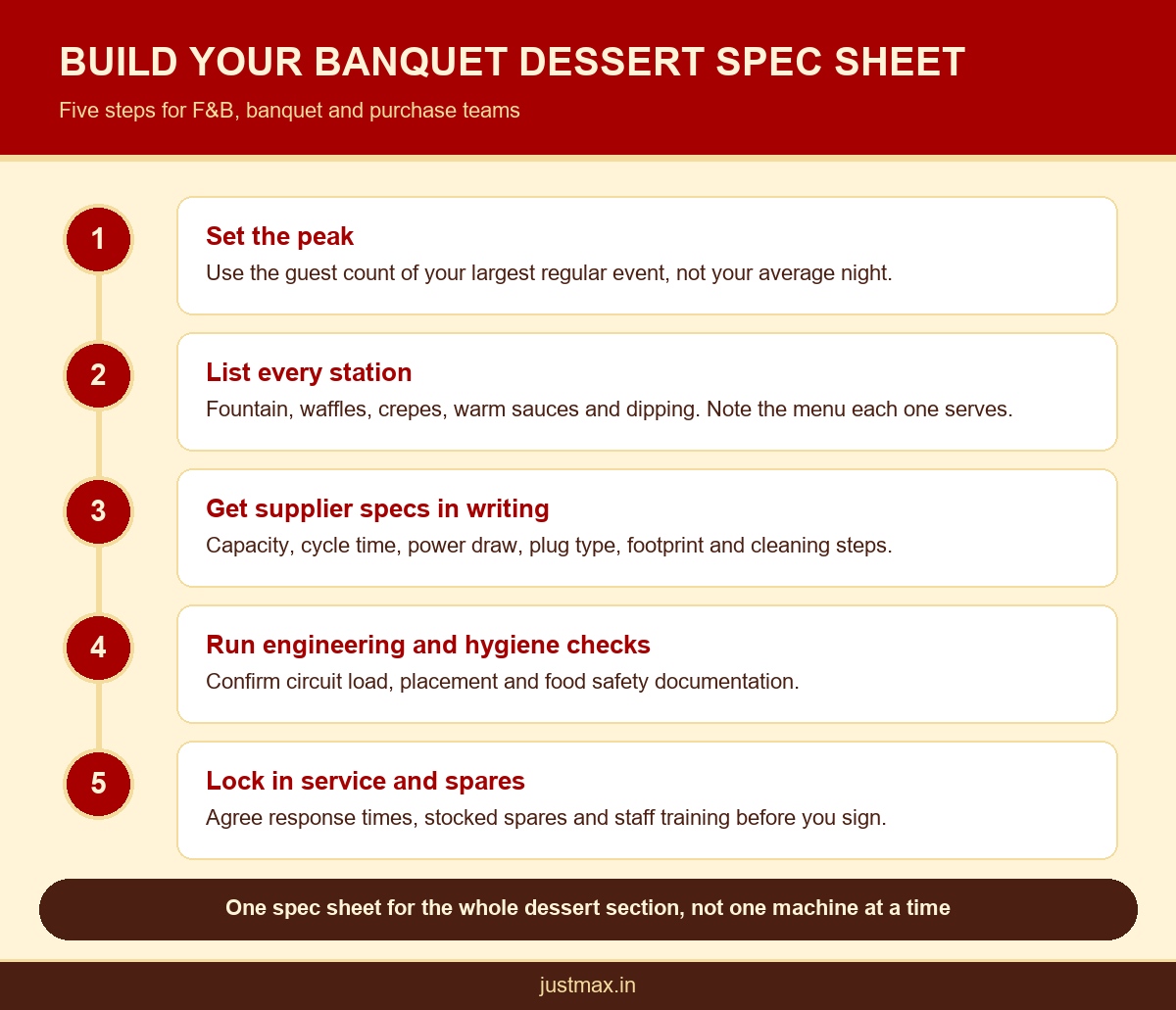
A Simple Spec Sheet Template You Can Copy
Use this template as a starting point for your next tender. Fill in one row per machine and keep it with your purchase file. It also helps when you add a station later, because the new unit must meet the same standard.
| Spec item | What to ask the supplier | Who signs off |
|---|---|---|
| Peak capacity | Rated output per hour at your largest event | Banquet manager |
| Power | Wattage, plug type and phase for each unit | Engineering |
| Footprint | Width, depth, height and working clearance | Banquet manager |
| Hygiene | Cleaning steps and food contact parts | Food safety lead |
| Service | Response time and named service contact | Purchase team |
| Spares and training | Stocked spares and installation training | Purchase team |
Share the completed sheet with every shortlisted supplier at the same time. Ask them to answer each row directly, with model names. Answers you cannot compare side by side usually signal a gap. A supplier that fills every row clearly is often the one that supports you best after installation.
Conclusion
A clear spec sheet turns professional catering equipment buying from guesswork into a repeatable process. Start with your peak guest count. Ask for capacity, power, footprint and cleaning details in writing. Then confirm service, spares and training before you sign. When every machine fits one plan, your banquet team serves faster and your purchase team spends less time firefighting. To plan a dessert section for your property, speak with the Just Max team or message us on WhatsApp at +91 88480 43729.
Frequently Asked Questions
What is professional catering equipment for a hotel dessert section?
It is commercial grade equipment built for long, high volume service, such as chocolate fountains, multi waffle machines, crepe makers, bottle warmers and dipping stations. It differs from domestic units in duty cycle, capacity, build quality and service support.
How many dessert stations does a 300 guest banquet need?
It depends on the menu and service window. Most planners size for the peak rush after the main course. Ask suppliers for rated output per hour, then add a second unit for popular stations to avoid queues.
Should hotels buy or rent dessert equipment?
Buying suits hotels that host regular weddings, brunches or conferences, because the equipment pays back over many events. Renting can suit one off events. Compare total cost over a year, including staff time, cleaning and transport.
What power checks are needed before installing buffet dessert equipment?
Ask each supplier for rated wattage, plug type and phase. Then have your engineering team confirm the circuit load for every machine running at once, including lighting. Plan cable routes so guests never cross power leads.
How should hotel banquet dessert equipment be cleaned?
Follow the manufacturer’s dismantling and cleaning steps after every service. Clean all food contact parts, dry them fully and log the clean. Fountains, dispensers and pumps need extra care because chocolate residue hardens quickly once cool.
Which chocolate fountain suits a hotel banquet?
It depends on guest count, counter space and the look you want. Compare Standard, Cascade and Multi Flow models in the Just Max fountain range, and ask for basin capacity and recommended guests per fill.
What after sales support should hotels expect?
Expect clear service contacts, stocked spares, installation training and documented cleaning steps. Just Max has manufactured dessert equipment in Kerala since 2002 and offers life long post sales service, which helps during busy wedding and conference seasons.
Can one supplier provide commercial dessert equipment and consumables?
Yes. Using one supplier for machines, premixes and spreads simplifies ordering, training and quality control. It also gives your team one point of contact if any station underperforms during a busy banquet or conference service.