Dessert Cafe Business Plan for India: Equipment, Menu, Costs and Licences
Most dessert cafes in India do not fail because the waffles are bad. They fail because the numbers were never written down. A cafe business plan forces you to answer the hard questions before you sign a lease: who you are serving, what you will sell, what equipment you need, how much power it draws, which licences apply, and how many orders a day it takes to break even. This guide walks through each part of a dessert cafe business plan for India in 2027, from choosing between a kiosk and a sit down cafe to building a menu around your equipment, planning the electrical load, registering with FSSAI and modelling your first year. Use it as a working template, and replace every illustrative figure with your own quotes.
Key Takeaways
- A good cafe business plan starts with the customer and the format, then builds the menu, equipment, licences and costs around them.
- Plan the menu around equipment you can share. One batter, interchangeable plates and a few topping jars can cover waffles, pancakes, cones and crepes.
- Write down power, licences and break even before you sign a lease, because these are the three things most first time owners discover too late.
What a Dessert Cafe Business Plan Must Answer
A business plan is not a document for the bank. It is a set of decisions you make on paper, where mistakes are cheap, instead of in a fitted out shop, where they are expensive. For a dessert cafe, those decisions fall into three groups: the concept, the location and format, and the numbers.
Keep the plan short and practical. Ten to fifteen pages with clear tables is far more useful than a long narrative. The aim is to be able to answer any question a partner, landlord or lender might ask, and to know which figures you are still guessing.
Revisit the plan every quarter once you open. Real sales, real costs and real customer feedback will replace many of your estimates, and an updated plan is the best tool you have for deciding when to add a product, a second site or a catering service.
The Concept and the Customer
Start with who you serve. College students, office workers, families on a weekend outing and wedding guests all want different things. Students want price and speed. Families want shareable plates and seating. Office crowds want a quick treat between meetings. Pick one primary customer and design everything around them.
Then describe your concept in one sentence. For example, a Belgian waffle and bubble cone counter for college students near a busy campus gate. That sentence decides the menu, the price points, the opening hours and the fit out, so write it before anything else in your cafe business plan.
Location and Footfall
Location sets your ceiling. Count the people who pass your shortlisted sites at the hours you plan to open, on a weekday and a weekend. Note how many look like your target customer. A site with half the footfall of a mall but twice the share of your customer can be the better choice.
Check the practical details too: rent and maintenance charges, the length of the lock in period, whether the landlord allows cooking appliances, the power supply available at the site, and space for storage. Many kiosk owners discover after signing that the site allows only a few kilowatts of load.
The Numbers
The numbers section turns your concept into money. It covers start up costs, monthly fixed costs, the cost and price of each menu item, expected orders per day, and the month you expect to break even. Every figure should have a source, whether a written quote, a supplier price list or a careful estimate you mark as such.
If you only have time for one table, make it the break even table. It tells you how many desserts you must sell each day to cover rent, salaries and power, and that single number tells you whether the location and the concept can work together.
Choosing Your Format: Kiosk, Counter or Sit Down Cafe
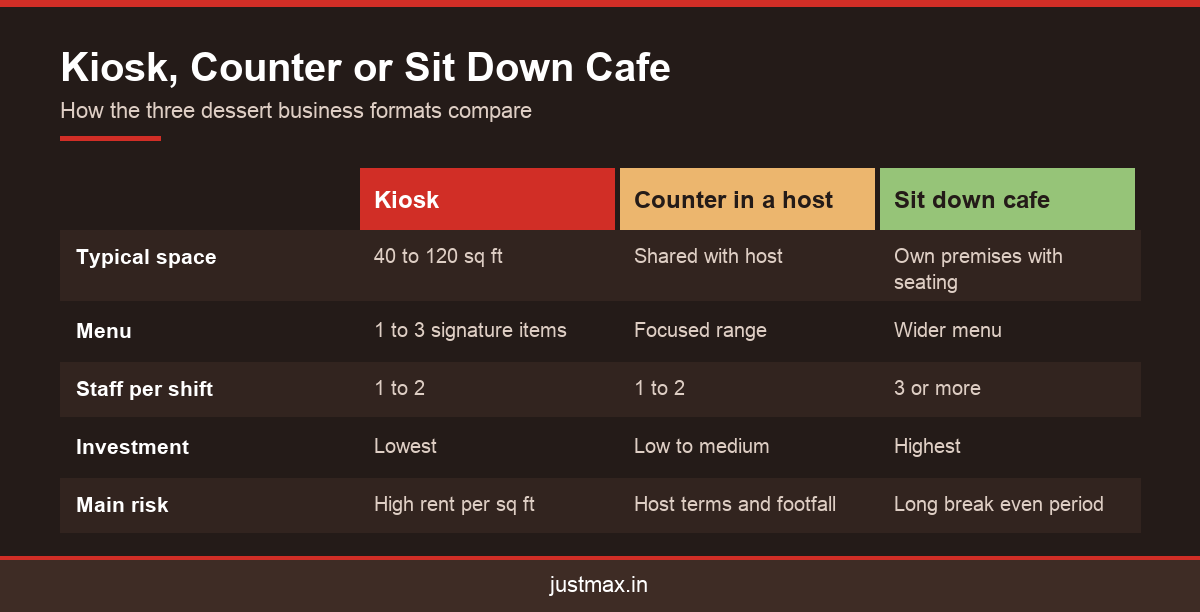
Your format decides almost every cost in the plan. The three common models for dessert businesses in India differ in space, staffing, investment and the kind of menu they can support. Choose the format that matches your customer and your budget, not the one that looks best on social media.
Whatever you choose, write down the hours, staffing and seating assumptions in the plan. Format changes are expensive once a lease is signed, so the time to compare them is now, side by side, with real rent figures from each shortlisted site.
Kiosk
A mall or street kiosk usually occupies 40 to 120 square feet. It suits one or two signature items, walk away formats such as cones and cups, and one or two staff per shift. Investment is lowest, but so is the menu range, and power and water are often limited. Rent per square foot is high, so speed and volume matter most.
Counter Inside an Existing Business
A dessert counter inside a cafe, bakery, food court or cinema shares rent, seating and footfall with the host. It suits owners who want to test a concept before committing to a standalone site. Agree power, storage and revenue share in writing before you install anything.
Sit Down Dessert Cafe
A standalone cafe with seating supports a wider menu, higher average bills and a stronger brand. It also carries the highest rent, fit out and staffing costs, and it needs a longer runway to break even. Plan at least two signature items that customers cannot easily find nearby, and keep the core equipment shared across the menu.
Building the Menu Around Your Equipment
The most profitable dessert menus are built backwards from equipment. Instead of choosing twenty desserts and buying a machine for each, choose two or three machines that can produce many formats, then design the menu around them. This keeps investment, counter space and training under control.
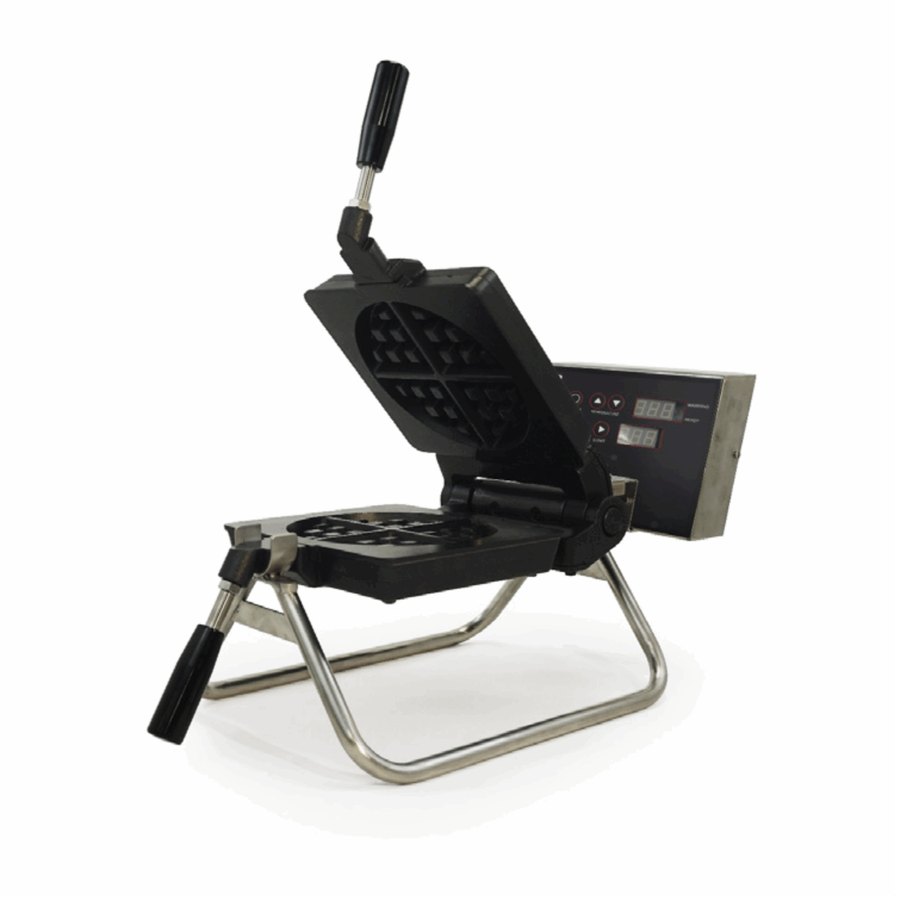
A multi waffle machine with interchangeable plates is the clearest example. One body can run Belgian waffles, bubble cones, stick waffles and mini pancakes simply by changing the plate, and the range of plate designs adds shapes without adding appliances. Add a crepe plate or a fountain only when the concept truly needs them.
Test the menu on paper before you buy anything. For each item, write the equipment it needs, the batter, the toppings, the cooking time and the selling price. If an item needs a machine nothing else uses, or takes twice as long as everything else, ask whether it earns its place. A tight menu of eight to twelve items, all made on three or four machines, is easier to run, easier to cost and easier for customers to choose from.
One Batter, Many Formats
Use a single batter across as many items as possible. A Belgian waffle and pancake premix that needs only water and oil covers waffles, pancakes, bubble cones and mini pancakes. Stocking one base instead of four reduces waste, simplifies ordering and makes every item taste consistent. The JustMax batter range offers vanilla, chocolate and red velvet bases for this purpose.
Toppings and Signature Items
Toppings carry the flavour and most of the margin. Choose three core toppings, usually a chocolate, a nut and a fruit option, plus one premium item such as pistachio. Jars of ready dessert toppings and warm sauces in bottle warmers make service fast and portions consistent. Then create two signature builds that only you sell, and photograph them for your opening campaign.
Seasonal specials keep regulars coming back without bloating the menu. A festive flavour for Onam, Diwali, Christmas or Ramadan, made from the same batter and equipment, gives customers a reason to return and gives you fresh content to post.
Equipment List and Power Planning
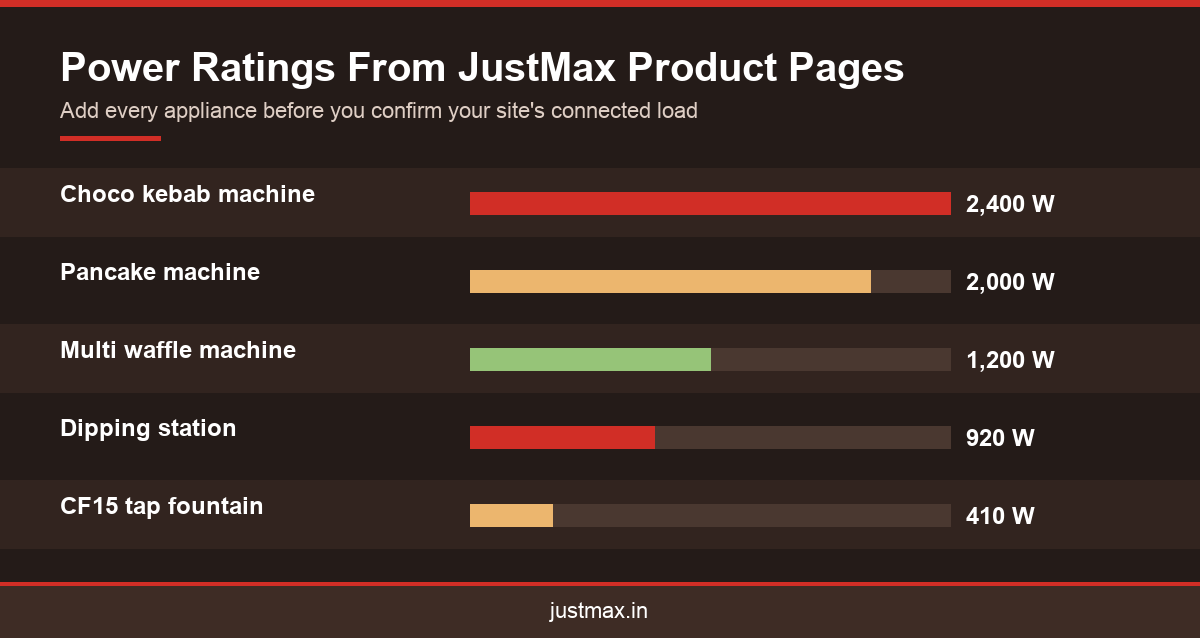
List every appliance in your plan with its power rating, its supply voltage and the socket it will use. This single table prevents the most common opening day problem in Indian dessert kiosks: tripping the supply when every machine heats up at once.
Use published specifications, not guesses. JustMax lists the ratings on each product page. Its multi waffle machines draw 1,200 W, its pancake machine 2,000 W, its CF15 tap fountain 410 W, its dipping station 920 W and its choco kebab machine 2,400 W. Add a chiller, a freezer, lighting and a billing system, then compare the total with the load your site actually provides.
Leave headroom. Machines draw the most power while heating up, and several heating at once can exceed the circuit rating even if the running load looks fine. Stagger start up times, give high load machines their own sockets, and ask an electrician to confirm the connected load with your local electricity board before fit out.
For a wider look at the machines themselves, our machine by machine equipment overview explains each appliance, and the waffle equipment guide for cafe owners goes deeper on waffle machines and plates.
Add maintenance to the equipment list. Note the warranty period for each machine, the spare parts most likely to wear, and who services them locally. Non stick plates eventually need recoating, fountains need seals and augers, and every machine needs daily cleaning time. Budget for these in your monthly costs rather than treating them as surprises.
Licences and Registrations in India
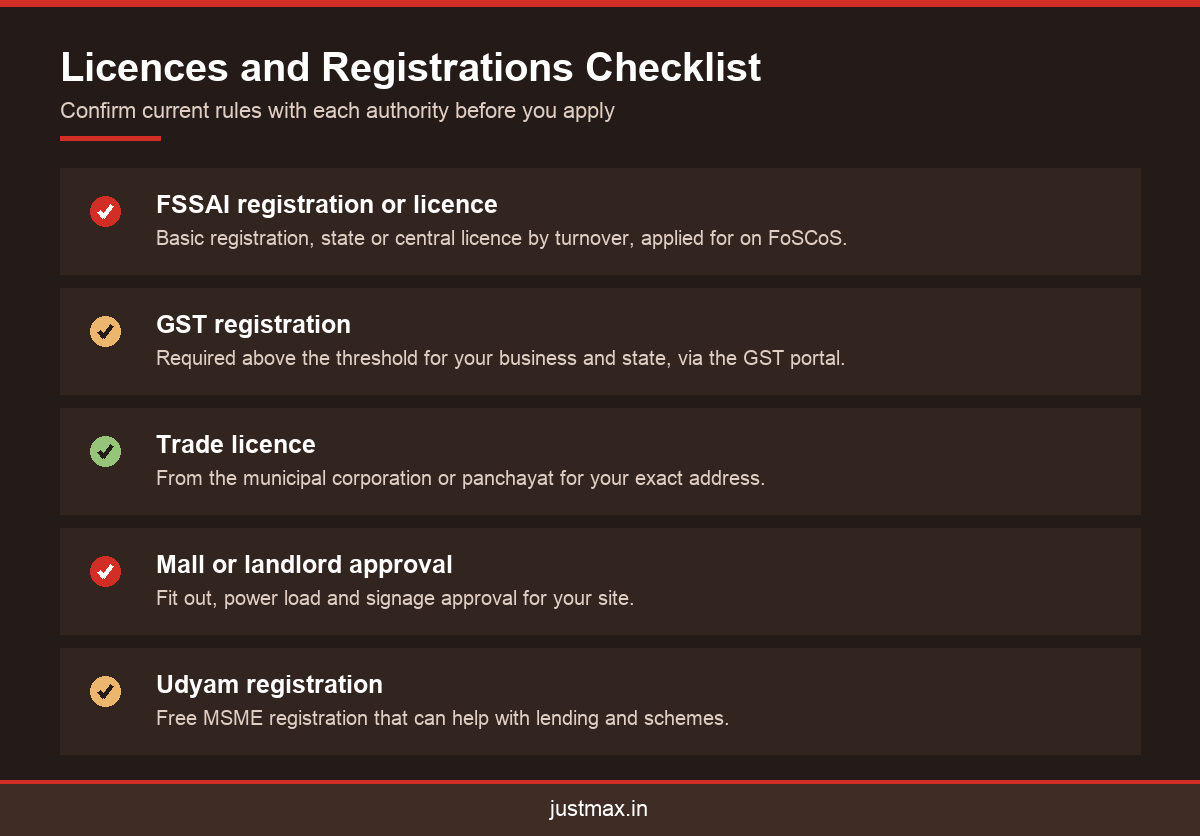
Every food business in India must register with or obtain a licence from the Food Safety and Standards Authority of India. Which one you need depends mainly on annual turnover. Applications are made online through the FSSAI FoSCoS portal, which also lists the current thresholds, fees and documents. Confirm them there before you apply, as they can change.
At the time of writing, small businesses with annual turnover up to ₹12 lakh need a basic FSSAI registration. Businesses above that level need a state licence, and very large operations above ₹20 crore need a central licence. Most new dessert kiosks and cafes start with registration or a state licence.
Keep copies of every certificate in one folder, with renewal dates in your calendar. Display your FSSAI registration or licence number at the counter as required, and check the latest rules on showing it on bills and menus. Expired or missing paperwork is one of the easiest problems to avoid, and one of the most disruptive when an inspector finds it.
GST Registration
You must register for GST once your turnover crosses the threshold that applies to your business and state, and some businesses register earlier to claim input credits or to sell through aggregators. Check the current rules and register through the official GST portal, and ask your accountant which rate applies to your outlet.
Trade Licence and Local Permissions
Your municipal corporation or panchayat issues a trade licence for operating a food business at a specific address. Malls often have their own approval process as well. Depending on size and seating, you may also need fire safety clearance and signage permission. Ask the local body for a complete list before you start fit out.
MSME Registration
Udyam registration is free and online. It records your business as a micro or small enterprise, which can help with priority lending and some government schemes. It takes a few minutes with your Aadhaar and PAN details.
Start Up Costs, Food Cost and Break Even
Divide your costs into one time and monthly. One time costs include the security deposit, fit out, equipment, the first stock order, licences and opening marketing. Monthly costs include rent, salaries, power, consumables, packaging, aggregator commissions and any loan repayments. Put each figure in a table with its source.
Next, cost every menu item. Weigh one real portion, add the cost of batter, toppings and packaging, add a small waste allowance, and divide by your selling price to get the food cost percentage. Many dessert businesses aim for food cost between roughly 20 and 30 percent, leaving the rest to cover fixed costs and profit.
Then calculate break even. Subtract the average food cost from the average bill to get your contribution per order. Divide your monthly fixed costs by that contribution to find the orders you need each month, and divide by the days you open to get a daily target.
Here is an illustrative example only. A kiosk with ₹1,50,000 of monthly fixed costs, an average bill of ₹180 and a 28 percent food cost earns about ₹130 per order. It needs roughly 1,150 orders a month, or about 40 a day over 29 trading days, just to break even. If the site cannot deliver that, change the format, the menu or the location before you commit.
Run the same calculation for a weak month as well as a normal one. Footfall in malls, colleges and tourist areas swings with exams, monsoon and holidays. If the plan only works in a good month, you need either more working capital or lower fixed costs before you open.
Buying smart lowers the variable cost on every order. Our guide to buying batter in bulk for a waffle business explains how pack sizes and ordering cycles change your cost per serving.
Staffing, Daily Operations and Marketing
Equipment and recipes only work if people use them the same way every day. This section of the plan describes who works each shift, how the counter runs from opening to closing, and how customers will hear about you.
Staffing and Training
List each role, the shifts it covers and the monthly cost. A kiosk may need two trained staff per shift, while a cafe adds a cashier, a cleaner and a supervisor. Plan for leave and turnover, which is high in food retail, so at least one extra person should know every recipe.
Train with station cards. Each card shows the batter weight, cooking time, topping weights and a photo of the finished item. New staff can then produce a consistent dessert within a day, and you can check portions quickly when costs drift.
Opening, Closing and Hygiene Routines
Write a short opening and closing checklist. Opening covers switching machines on in sequence, checking batter and toppings, and setting out packaging. Closing covers cleaning plates while warm, storing open jars correctly, recording waste and switching off equipment safely.
Hygiene is part of the routine, not an extra. Keep dairy toppings chilled, label opened containers with the date, and keep cleaning records. Inspectors and customers both notice a clean, organised counter, and good routines reduce waste as well as risk.
Marketing the Opening
Budget for the launch. A dessert counter lives on photographs, so plan two signature items that look striking on camera and post them daily in the first month. Invite local food pages and nearby offices to the soft launch, and set up your listing on maps and delivery apps before opening day.
Plan offers carefully. A launch week combo or a loyalty card brings people back, while a permanent discount trains them to wait for one. Measure every campaign against orders, and keep only the ones that pay for themselves.
Funding, Launch and the First Ninety Days
Most first dessert cafes are funded by the owner’s savings, family, a small business loan or a combination. Government backed schemes can help. The Pradhan Mantri MUDRA Yojana supports loans to micro enterprises through banks and other lenders, and a clear plan with equipment quotations makes any application stronger.
Ask equipment suppliers for formal quotations that include specifications, warranty and delivery. Lenders and investors want to see exactly what their money buys, and comparing written quotes also protects you from hidden extras.
Hold back a contingency fund of at least two to three months of fixed costs. Openings slip, fit outs overrun and the first months are usually slower than forecast. A cash cushion lets you fix problems calmly instead of cutting quality or prices in a hurry.
A Soft Launch Before the Opening
Open quietly for a week before the official launch. Invite friends, neighbours and nearby shop staff, test every recipe at real speed, and time each order. Fix the station cards, portion sizes and layout while the stakes are low. A soft launch catches most of the problems that would otherwise appear on opening day.
Tracking the First Ninety Days
Track daily orders, average bill, best sellers and waste from the first day. Compare them weekly with your plan. If orders fall short, test a new signature item or a time based offer rather than a permanent discount. If a product rarely sells, remove it and simplify the menu.
Use the numbers to decide your next step. A busy cafe with spare capacity can add catering, as our guide to adding a dessert catering arm in Kerala shows, or a delivery menu for cloud kitchen style ordering.
Conclusion
A dessert cafe business plan does not need to be long, but it must be honest. Choose one customer and one format, build the menu around equipment that can produce many items, list every appliance with its power rating, register with FSSAI and your local body, and calculate how many orders a day it takes to break even. Replace every illustrative figure with real quotes and update the plan as you learn. With the cafe business plan written down, decisions become easier, conversations with lenders become clearer, and opening day becomes far less risky. When you reach the equipment stage, speak with the JustMax team for specifications and quotations to put into your plan.
Frequently Asked Questions
What should a cafe business plan include?
It should cover your target customer, concept, location and format, menu and pricing, equipment and power, licences, start up and monthly costs, food cost per item, break even orders per day, funding and a launch plan. Keep each section short, clear and sourced.
How much does it cost to open a dessert kiosk in India?
It varies widely with city, site, fit out and equipment. Build your own estimate from written quotes for rent deposit, fit out, machines, first stock, licences and marketing. Then add at least three months of fixed costs as working capital.
Which FSSAI licence does a small dessert cafe need?
Most new kiosks and small cafes need either a basic FSSAI registration or a state licence, depending on annual turnover. Check the current thresholds and apply online through the FoSCoS portal, which lists fees and required documents.
What equipment does a dessert cafe need to start?
Start with a few versatile machines. A multi waffle machine with interchangeable plates, a sauce warmer, a chiller and a freezer cover many menus. Add a crepe plate, fountain or pancake machine only when your concept and volumes justify them.
How do I calculate break even for a dessert cafe?
Subtract average food cost per order from the average bill to get contribution per order. Divide monthly fixed costs by that figure to find monthly orders needed, then divide by trading days to get the daily target.
How much power does dessert equipment need?
Check each product page. JustMax lists 1,200 W for its multi waffle machines, 2,000 W for its pancake machine and 410 W for its CF15 fountain. Add chillers, freezers and lighting, then confirm the connected load available at your site.
Is a kiosk or a sit down cafe better for a first business?
A kiosk needs less investment and suits a narrow, fast menu, while a sit down cafe supports a wider menu and higher bills but costs more. Many first time owners test the concept as a kiosk or counter before opening a full cafe.
Can I get a loan for cafe equipment in India?
Yes. Banks and other lenders offer small business loans, and schemes such as MUDRA support micro enterprises. A written business plan with formal equipment quotations makes your application stronger. See the JustMax distributor and partner programme if you plan to resell equipment.
Do I need a cafe business plan template to start?
A template helps you avoid gaps, but a simple document with your own tables works just as well. Use the sections in this guide as headings, fill in real quotes and figures, and mark clearly anything that is still an estimate.
Where can I buy dessert cafe supplies in India?
Specialist dessert suppliers sell machines, plates, premixes and topping jars for commercial use across India. Browse the JustMax online store for supplies sized for cafes and kiosks, and ask about regular delivery once your volumes settle.