Commercial Waffle Maker for Cafe Owners: Equipment Guide
Choosing a commercial waffle maker for cafe service used to be a single decision about a single machine. It is not any
more. The interesting equipment now takes interchangeable plates, which means one purchase can produce a dozen
different products, and the plate library matters more than the machine badge. This guide covers the machine families,
the plate range and what each shape is commercially for, real throughput, coating and changeover economics, layout,
and how to match batter to pattern. Just Max manufactures this category rather
than reselling it.
Key Takeaways
- Buy the plate library, not just the machine. Interchangeability is what turns one unit into several menu lines.
- Throughput is set by plate recovery time and operator flow, not by the number printed on a spec sheet.
- Plate coating is a maintenance line to budget for, exactly like a heating element.
- Match plate shape to batter behaviour. A thin batter in a deep pattern is a bad pairing, not a bad machine.
Why interchangeable plates beat a fixed iron
A fixed pattern iron makes one product. An interchangeable machine makes as many products as you own plates for, from
the same footprint, the same circuit and the same trained operator. For a cafe with limited counter space that is not
a small advantage, it is the whole argument.
The commercial effect shows up in menu flexibility. A venue can run Belgian waffles on a weekday, switch to cones for
a summer promotion, add heart shapes for a seasonal week, then trial a bun format without buying anything except a
plate set. Testing a new item stops being a capital decision and becomes an operational one, which changes how willing
a small operator is to experiment at all.
This is the main reason a commercial waffle maker for cafe use has largely displaced fixed irons in new fit outs. The
machine is no longer the thing you are buying; it is the platform the plates sit on. Judged that way, the right
question shifts from which iron makes the best waffle to which platform will still be accepting new plates in five
years, which is a question about the manufacturer rather than about the specification sheet.
What interchangeability actually costs
There is a training cost as well. Each pattern has its own batter volume, its own timing and its own release
behaviour, so a venue running four plates is effectively asking staff to learn four products. That is manageable with
a station card per plate and unmanageable without one, which is why plate count should follow team stability rather
than menu ambition.
Plates are not free and changeover is not instant, so the flexibility has a price. A plate swap on a hot machine needs
cool down time, or heat protection and a careful operator, which means you cannot switch formats mid rush. Most venues
settle on one plate per service period rather than switching on demand, and that is the realistic way to plan a menu
around this equipment.
There is a storage cost too. Plates are heavy and need somewhere clean, dry and protected to live, because a plate
stacked carelessly against another will damage its coating long before use does. Budget shelf space, not just money.
One machine, several menu lines
The other benefit is inventory. A single batter, or a small set of mixes, feeds every plate you own, so adding a
format does not add a new ingredient line. That is why plate led menu expansion is cheaper than almost any other
route, and why the plate range deserves as much attention as the machine. Our comparison of
multi plate against fixed machines
covers the decision in more detail.
The three machine options
Just Max builds three units in this family. They differ in capacity and control rather than in the plates they accept,
so the choice is about volume and consistency requirements rather than about what you can make.
Regular
The regular unit carries one plate set with
straightforward thermostat control. It suits cafes adding waffles as a supporting line rather than a headline, and
venues where a single format covers the whole menu. It is the lowest capital entry into the plate ecosystem, and for a
cafe testing whether waffles sell at all it is the sensible starting point.
Premium
The premium unit adds tighter temperature and
timing control, which matters across a long shift rather than in the first few covers. If your problem is that hour
six looks different from hour one, this is the answer. It suits dessert led venues where the waffle is the product
rather than the accompaniment, and where an inconsistent finish would be noticed and photographed.
Double
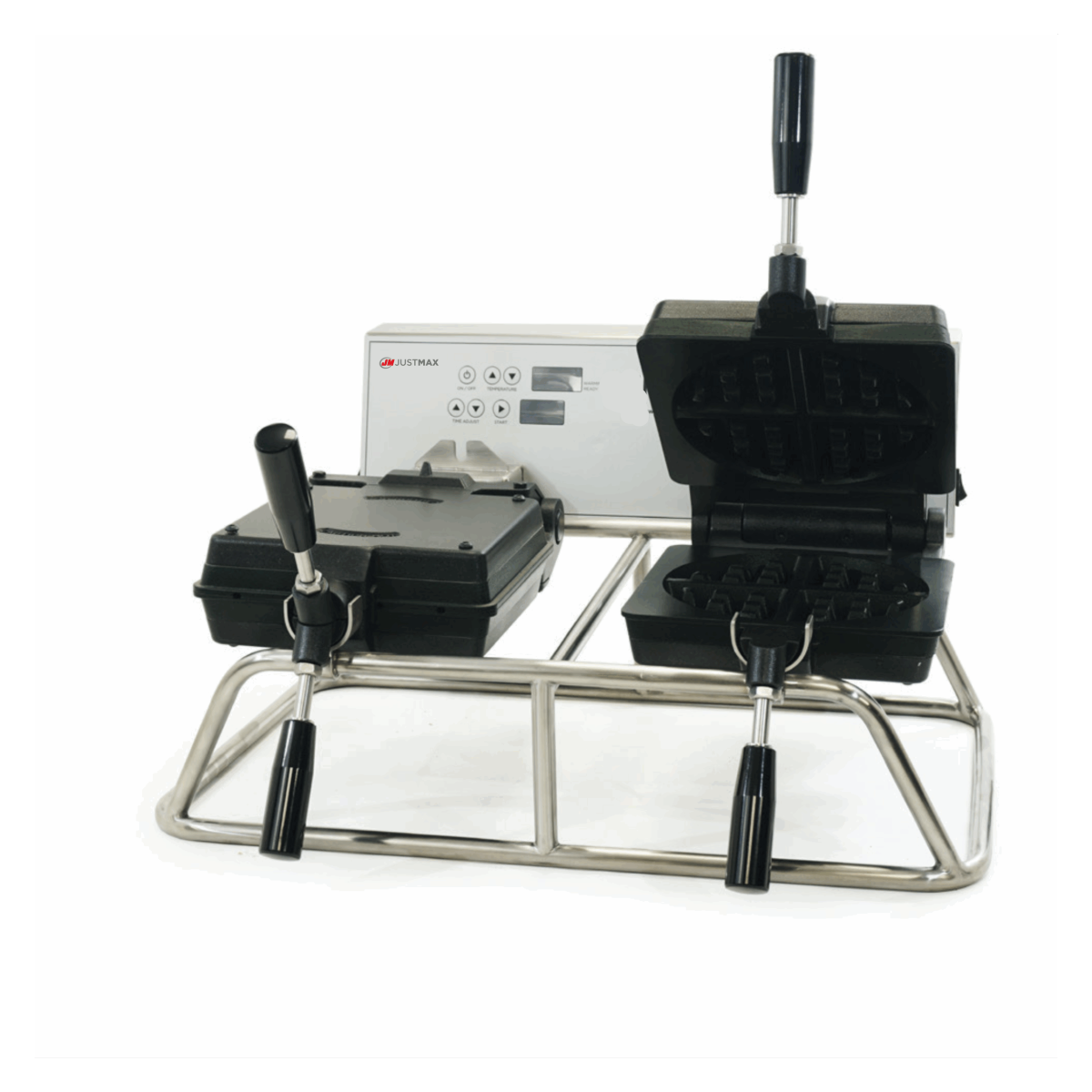
The double unit carries two plate sets on one frame,
which is the genuine throughput answer and also the only practical way to run two formats simultaneously. High
footfall kiosks and venues running both a savoury and a sweet line usually end up here. It is worth noting that a
double unit is not simply two machines’ convenience, it is a real electrical load that needs planning for.
The plate library and what each shape is for
There are seventeen plate patterns in the range, and they are not decorative variants. Each one has a commercial job,
and choosing badly is how venues end up with a plate they used twice and then stored.
The core sellers are the traditional formats. The
Belgian plate produces the deep pocket
waffle most customers picture when they order, a thin Belgian version gives a crisper and faster cooking result that
suits high volume, and a round Belgian mini portions the format down for platters and children’s menus.
Geometric plates serve throughput and packing. Square and small square formats stack and box efficiently, which
matters a great deal if delivery is a real channel, because round waffles in square boxes waste volume and arrive
damaged more often. Bubble plates produce the Hong Kong style waffle with strong social appeal, and a cone plate turns
the waffle into a vessel, which is one of the better upsell mechanics available on a dessert counter.
Novelty and format plates cover the rest. A stick plate makes a handheld walking format ideal for kiosks and
festivals, a stuffed plate encloses a filling, and heart and seasonal character plates serve promotional weeks and
family trade. Biscuit, American pancake and mini pancake plates move the machine outside waffles entirely, and a bun
plate produces a distinctive burger bun without running a bakery. The whole
plate category lists each pattern
individually with its specification.
The buying discipline that matters here is to resist owning the whole library. Every plate you buy needs storage,
needs its coating protected, and needs a menu item behind it that actually sells. Two or three well chosen patterns
worked hard will earn more than nine bought on enthusiasm, and a plate that gets used twice a year is worse than one
you never bought, because it also occupies shelf space and encourages a menu you cannot execute consistently.
There is a useful sequencing rule. Buy your core pattern with the machine. Add a packing oriented shape once delivery
becomes a meaningful share of revenue. Add a novelty pattern only when you have a promotion planned and someone
accountable for running it. Add specialist plates last and only against a specific menu decision that has already been
made.
The Plate Library, Grouped by Commercial Purpose
| Purpose | Plates | Why you would buy it |
|---|---|---|
| Core sellers | Belgian, thin Belgian, round Belgian mini | The formats customers already expect; thin cycles faster for volume |
| Throughput and packing | Square, small square, American pancake, mini pancake | Stack and box efficiently, which matters for delivery channels |
| Upsell and social | Bubble, cone, stick, heart, seasonal character | Formats that photograph well and support a price premium |
| Format extension | Stuffed, biscuit, burger bun | Take the machine outside waffles, including buns without a bakery |
Start with two or three plates. Add patterns once you know which formats your customers actually repeat on.
What a station actually produces per hour
Published output figures assume ideal conditions and a machine that never waits. Real throughput is set by three
things, and only one of them is the machine you bought.
Plate recovery time is the first. After a waffle is lifted, the plate needs to return to temperature before the next
pour, and deeper patterns take longer than shallow ones. A thin Belgian plate cycles faster than a deep pocket plate
on the identical machine, which is why plate choice is a throughput decision as much as a presentation one.
Operator flow is the second and usually the binding constraint. If the same person pours, lifts, tops, plates and
takes payment, the machine spends most of its time idle. Splitting finishing from cooking typically lifts real output
more than buying a bigger machine does, and it costs a fraction as much.
Batter readiness is the third. A station that mixes batter between orders is not a production line. Pre mixing to a
written ratio and holding it correctly removes that stall, which is one reason venues standardise on ready mixes as
covered in our
premix comparison.
Taken together, these three explain why two identical machines in two cafes can deliver very different hourly numbers.
A practical way to find your real number is to time a full peak hour rather than a single waffle. Count what actually
left the counter, then work out where the waiting happened. Most operators are surprised to discover the machine was
idle for a substantial part of the hour while the operator was topping, packing or taking payment, which is a staffing
fix rather than an equipment one and costs almost nothing to implement.
Queue design belongs in this conversation too. A single service point in front of one machine creates a bottleneck no
equipment can solve, whereas separating ordering, cooking and collection lets the machine run continuously. If you are
fitting out a new site, this is far cheaper to get right on the drawing than to retrofit once the counter is built.
What Actually Limits Throughput
-
Plate recovery time The plate must return to temperature before the next pour. Deep patterns cycle
slower than shallow ones on the identical machine. -
Operator flow One person pouring, topping, plating and taking payment leaves the machine idle.
Splitting finishing from cooking usually lifts output more than a bigger machine does. -
Batter readiness A station mixing batter between orders is not a production line. Pre mix to a
written ratio and hold it properly to remove the stall.
Plate coating, changeover and running costs
Plates are wear items and this is the cost line most buyers miss entirely. The non stick coating on a plate degrades
with use, with thermal cycling and above all with abrasive cleaning. Once it goes, waffles tear on release and the
plate stops being usable even though it looks structurally fine.
The good news is that plates can be re coated rather than replaced, which is substantially cheaper. Just Max lists
platen coating as a service precisely because it is a
predictable maintenance need rather than a failure. Budget for it on any plate in daily use, in the same way you would
budget for a heating element.
You can extend coating life considerably with three habits: never use metal tools on a plate face, clean while warm
with a soft cloth rather than scraping cold residue, and store plates separated rather than stacked against each
other. Changeover cost is mostly time rather than money, and the practical answer is to schedule format changes
between service periods rather than within them.
Alongside coating, the other recurring lines are batter, toppings, power and cleaning labour. None of them is large
individually, but a station running daily accumulates them, and a cafe that has only budgeted for the machine will
find its waffle margin thinner than expected in year two.
Waste deserves a specific mention because it is the most controllable of these lines. Batter mixed to habit rather
than to a forecast, waffles cooked ahead during a lull and then thrown away, and toppings decanted in quantities the
service never used all erode a very healthy gross margin. Cook to order wherever the queue allows it, and mix against
a number rather than against a jug.
There is a straightforward way to keep visibility on all of this. Track cost per waffle monthly, including batter,
topping, an allowance for coating and a share of cleaning labour, and watch the trend rather than the absolute figure.
A rising number is an early signal of either waste creeping in or a plate approaching the end of its coating life, and
both are much cheaper to address early.
Power, footprint and counter layout
Three physical checks decide whether the station works. Electrical load first: these machines hold temperature
continuously through service, so treat the draw as steady rather than intermittent and have an electrician confirm the
circuit. Certification practice for commercial electrical appliances is set by the
Bureau of Indian Standards, and it is worth looking for recognised marks on any
heated unit you buy.
Footprint second, and measure the working envelope rather than the machine. Plates open upward and rotate on some
models, so you need vertical clearance and space for the operator’s hands without reaching across a hot surface.
Third, the finishing area. Waffles need somewhere to land and be topped, and stations that omit this end up plating on
the machine itself, which is both slow and unhygienic.
On visibility, waffle cooking is mildly theatrical and the smell genuinely sells, so a guest facing position earns
more where the layout allows it. Where energy cost is a concern, the
Bureau of Energy Efficiency publishes useful general guidance on commercial
appliance consumption that is worth reading before you commit to a large or double unit.
Station Layout and Installation Checks
- Have an electrician confirm the circuit against a steady, not intermittent, load
- Look for recognised certification marks on any electrically heated unit
- Measure the working envelope including upward plate opening and any rotation
- Provide a dedicated finishing and topping area away from the machine face
- Leave hand clearance so operators never reach across a hot surface
- Hold toppings at serving temperature so a warm waffle meets a warm sauce
- Position guest facing where layout allows; the cooking smell genuinely sells
- Allocate clean, dry, separated storage for plates that are not in use
- Hold a spare heating element and know where plate re coating is done
- Write the plate and batter ratio onto a station card rather than relying on memory
Matching plates to batter
This is the part almost nobody plans and it causes more disappointment than any machine fault. Plate geometry and
batter viscosity have to suit each other.
A deep pocket pattern needs a batter with enough body to hold its structure as it rises into the pattern. A thin,
loose batter in a deep plate produces a waffle that collapses and sticks. Conversely a very thick batter on a shallow
or finely patterned plate does not flow into the detail, so the pattern comes out soft and undefined. Neither of these
is an equipment problem, though both get reported as one.
The practical approach is to fix your plate choice, then dial the batter to it, and write the ratio down on a station
card. Just Max manufactures its own
waffle and pancake mixes in vanilla, chocolate
and red velvet, which makes matching predictable rather than experimental, and the finished product is normally paired
with the spread range for topping. Venues buying
at volume should read the
bulk buying guide
before placing a first order.
Resting time is part of the same equation and is routinely skipped. Batter used immediately after mixing behaves
differently from batter that has stood, because the flour has not fully hydrated, so the first waffles of the day come
out different from the rest. Fix a standing time, put it on the card, and the variation disappears.
If you run more than one plate, keep a separate ratio for each. It feels fussy and it takes ten minutes to establish,
but it is the difference between a cone that holds its shape and one that collapses when a scoop goes into it. Record
what worked the first time you got it right, because nobody remembers it three months later.
Buying, service and spares
Equipment in this category runs for years, so the support position matters as much as the specification. Three
questions separate suppliers quickly. Are you the manufacturer? What is your parts position on this exact model in
three years? What does after sales cover, in writing rather than in conversation?
Wear parts on a waffle station are the heating element, the hinge and latch mechanism, and the plates themselves. A
venue running daily should hold a spare element and know where re coating is done before it is needed rather than
after. The hinge is the component people forget: it carries the weight of a hot plate hundreds of times a day, and a
loose one produces uneven pressure that shows up as a waffle browned on one side. Food business registration is held
through the FSSAI portal, and standard hygiene and cleaning records apply
as they would to any hot station.
Just Max manufactures from a plant in Kerala and supplies hospitality and retail operators in India and
internationally through appointed partners, which is set out on the
partner network page. Overseas buyers should approach their regional
contact rather than ordering directly from the Indian site, because spares and service run through the same route.
Plan the handover as carefully as the purchase. A machine delivered without anyone shown how to set temperature,
change a plate safely or clean the hinge will be operated by guesswork, and guesswork is what destroys coatings and
elements early. Ask for commissioning and a short training session as part of the order, and have whoever will
actually run the station present for it rather than only the owner.
Finally, keep the paperwork somewhere findable. The model number, the purchase date, the warranty terms and the
supplier contact belong together in one place, because the moment you need them is the moment a station has gone down
mid service. A photograph of the rating plate on the machine, stored with the invoice, saves a surprising amount of
time later.
Conclusion
Specifying a commercial waffle maker for cafe service is really two decisions. The machine sets your capacity and your
consistency across a long shift, and the plate library sets what you can actually sell. Choose the machine for volume,
build the plate set around the menu you want to test, budget coating as a maintenance line, verify power and
clearance, and match your batter to the pattern you have chosen. A commercial waffle maker for cafe service specified
that way will still be earning in five years, because you will be able to keep changing what it produces without
changing what you own. Ask for commissioning and operator training as part of the order, and keep the model number,
warranty and supplier contact filed together where whoever is on shift can find them.
Browse the machines and plates or
send us your menu and peak covers for a specification built around your
counter.