
Commercial Chocolate Fountains: The Complete Buyer’s Guide
A chocolate fountain is one of the few pieces of dessert equipment that pays for itself twice, once in margin and once
in attention. It draws a queue, it photographs well, and it turns a cheap ingredient into a premium ticket item. It
also punishes bad buying decisions faster than almost anything else on a dessert counter. This guide covers what the
machine actually does, how to size one, what to pour into it, what it costs to run across a season, and what Indian
food safety rules expect from you.
Just Max has manufactured this category since 2002, so the guidance here
reflects installed machines rather than catalogue theory.
Key Takeaways
-
Size to your busiest realistic service window, not your average one. Undersizing shows up as a queue and a cold
basin. -
The chocolate matters more than the machine. Fountain grade product with the right fat content flows; ordinary
couverture seizes. -
Budget for consumables, labour and cleaning time, not just the purchase. Those three decide whether the unit is
profitable. -
Public dessert service in India carries real hygiene duties. Register, document your cleaning, and train whoever
runs the counter.
What a commercial fountain actually does
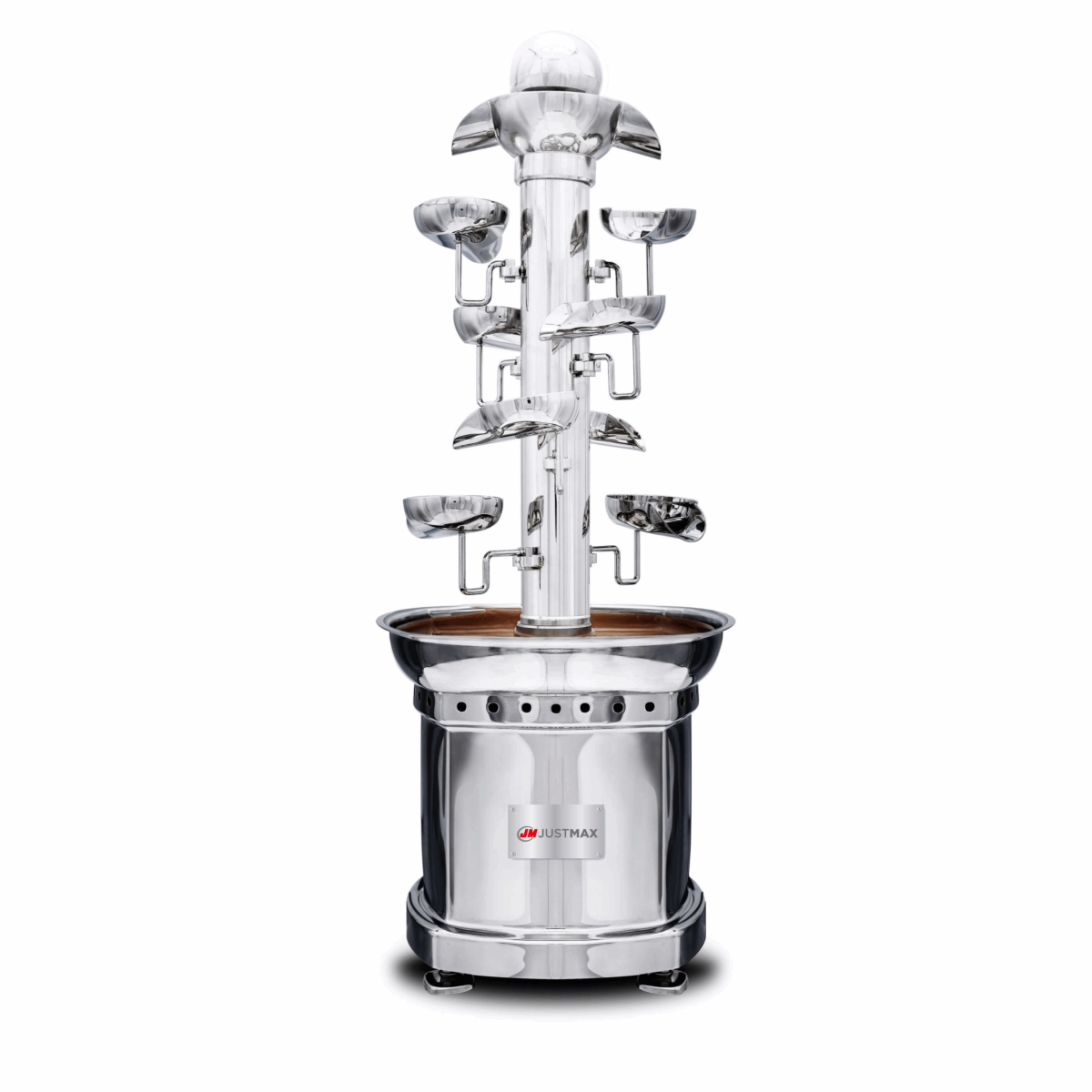
Strip away the theatre and a chocolate fountain is a heated basin, a vertical auger, and a set of tiers. Melted
chocolate sits in the basin, the auger lifts it up the central column, and it falls back down over the tiers in a
continuous curtain. Everything that makes the difference between a beautiful curtain and a stuttering dribble happens
in three variables: temperature, viscosity and flow rate. Get those right and the unit runs unattended for hours. Get
them wrong and you spend the evening apologising.
That is why buying decisions should start with the service you want to run rather than with the shape of the machine.
A boutique cafe adding a weekend dessert feature has a completely different problem from a banquet hall serving eight
hundred covers. Both can be solved, but not by the same unit. The full
range of appliances is organised around exactly that
distinction.
It is worth being clear about what the machine is not. A chocolate fountain is not a melting device. It is designed to
hold already melted product at a working temperature and keep it moving, and asking it to melt solid chocolate from
cold is the fastest way to scorch the base and produce a burnt note that never leaves the batch. Melting happens
somewhere else, in a bain marie or a dedicated melter, and the basin receives product that is already fluid.
The auger and basin, and why they set your limits
The auger determines how much chocolate can be in motion at once, and the basin determines how long you can run before
a refill. A larger basin is not simply better. More chocolate in the basin means more product at risk if service is
cancelled, and a longer warm up before the first guest. Think in terms of your service window. If you run ninety
minutes of heavy dessert service, you want a basin that comfortably covers ninety minutes plus a margin, not one that
covers four hours.
Auger design also explains why some units tolerate a thicker product than others. A larger diameter auger moves more
volume per rotation and copes better with a slightly heavier chocolate, which is one reason the bigger machines in a
range feel more forgiving in practice than their specifications suggest.
Viscosity is the variable most buyers ignore
Chocolate flows because of fat, not because of heat alone. Push the temperature up to compensate for a product that is
too thick and you scorch it. The correct answer is a product formulated to fall in a sheet at normal working
temperature. This is the single most common cause of a disappointing first event, and it is an ingredient problem
wearing an equipment costume.
The diagnostic is simple. If the curtain looks thin and ragged, the product is usually too cool or too thick. If it
looks glossy but tastes flat and slightly burnt, the product has been held too hot for too long. If the sheet breaks
into strands halfway down, check the basin level before anything else, because a falling level starves the auger.
The Three Variables That Control Fountain Flow
-
Temperature Holds the chocolate at working consistency in the basin and up the auger. Too low and
the sheet thickens and splits. Too high and the product scorches and tastes flat. -
Viscosity Set by fat content in the product, not by the machine. This is the usual culprit behind a
disappointing first event. Fix it with the right chocolate, not more heat. -
Flow rate How much chocolate the auger keeps in motion against basin level. A falling basin breaks
the curtain before anything else does. Top up early rather than late.
The four Just Max fountain families
The catalogue splits into four families. They are not quality tiers. They are different service shapes, and choosing
across families is a bigger decision than choosing a size within one. A venue that gets the family right and the size
slightly wrong will still have a workable machine. A venue that buys the wrong family will not.
Standard tiers
The classic conical silhouette, with chocolate falling evenly around a central column. It is the most forgiving family
to operate and the easiest to clean, which matters when the person breaking it down at midnight is not the person who
bought it. The
standard tier models run
from the compact SQ1 up to the SQ3, which suits boutique cafes, small private functions and dessert counters that need
presence without a large footprint.
Cascade tiers
Cascade units break the curtain into distinct falling steps, which reads as more dramatic under lights and gives
guests more surface to dip against. The
cascade selection covers SQ1
through SQ3 plus a leaf profile that is popular for weddings. Cascades reward good chocolate and punish thin product,
because every break in the fall is a chance for the sheet to split. They also take slightly longer to clean, since
there are more surfaces for product to set on.
Multi flow tiers
Multi flow units are built for continuous service at volume. Instead of one curtain they present several flow paths,
so more guests can dip simultaneously without crowding a single face. The
multi flow models scale
from SQ2 up to SQ6, including a tall SQ4 variant for venues where the unit needs to be seen across a room. This is the
family for theme parks, malls, large banquets and any counter with a genuine queue. The practical advantage is queue
geometry: three people can serve themselves at once without anyone reaching across anyone else.
Tap dispensing
The CF15 tap unit is the outlier and often the
smartest buy. It holds chocolate at temperature and dispenses on demand through a tap rather than running an open
curtain. There is no spectacle, but there is also almost no waste, no exposure and far less cleaning. For kitchens
that want warm chocolate as an ingredient rather than as a show, it is usually the correct answer, and many venues
eventually own one of these alongside an open unit.
Sizing to guest count and service window
Sizing is where most money is lost. The instinct is to buy for the biggest event you can imagine, which leaves a large
unit running half empty at every normal service, wasting chocolate and warm up time. The better method is to size for
your busiest realistic window and accept that a genuinely exceptional booking can be served with two smaller units
placed apart, which also shortens queues.
Work through three numbers before you shortlist anything. First, peak concurrent guests, meaning how many people will
be at the counter in the same ten minutes rather than across the whole night. Second, service duration, because a two
hour window needs refill planning that a forty minute window does not. Third, whether the fountain is a self service
feature or staffed, since a staffed counter moves roughly twice as many covers through the same footprint.
As a planning rule rather than a specification, treat compact standard units as suited to intimate counters, mid range
standard and cascade units as suited to weddings and corporate functions, and multi flow units as the only sensible
choice where a queue is expected to persist. Confirm the figures for any specific model against its own product page
before you commit, because basin capacity and tier count vary within each family.
One sizing mistake deserves its own warning. Buying a large unit and running it below its minimum working level does
not give you a small fountain, it gives you a broken looking one. Below a certain basin level the auger cannot sustain
an even sheet, so the curtain stutters and the machine reads as faulty to every guest who sees it. If your normal
service is small and your occasional service is large, two appropriately sized units genuinely beat one oversized one.
A final point on sizing that applies to every family. A chocolate fountain is judged by guests on whether the curtain
looks full, not on how large the machine is. A modest unit running a perfect sheet reads as premium; a large unit
running a broken one reads as neglected. If you are choosing between a bigger machine at the edge of your budget and a
smaller one you can afford to run properly with good chocolate, take the smaller one every time. The same logic
applies to hire: a rented chocolate fountain that arrives without enough product to fill it properly will disappoint
more than no dessert feature at all.
Sizing Guidance by Service Shape
| Service shape | Typical venue | Suited family | Staffing |
|---|---|---|---|
| Intimate counter | Boutique cafe, small private function | Compact standard | Often self service |
| Mid size function | Wedding, corporate event, hotel banquet | Standard or cascade | Staffed at peak |
| Persistent queue | Theme park, mall kiosk, large banquet | Multi flow | Dedicated attendant |
| Ingredient use | Commercial kitchen, plated dessert service | Tap dispensing | Kitchen staff only |
Two smaller units placed apart usually beat one oversized unit: shorter queues, less chocolate at risk, faster warm
up.
Chocolate, consumables and the equipment around the unit
The machine is the smaller half of the system. What you pour matters more, and so does the equipment that gets
chocolate into and out of the basin.
Use a product formulated for fountains. It carries enough cocoa butter to fall in a sheet without thinning agents, and
it holds at working temperature without scorching. Ordinary bar chocolate and most standard couverture will need oil
added to flow, which dulls the taste and leaves a greasy mouthfeel that guests notice even when they cannot name it.
The saving on product is almost always smaller than the cost of a dessert counter that underwhelms.
Around the basin, two accessories change the operating experience more than anything else. A
filling pump moves melted chocolate from a
melting vessel into the basin without ladles, which cuts refill time and spillage during service. A
chocolate dispenser gives you controlled portions for
plated desserts and takeaway, so the open unit is not the only way chocolate reaches a guest. Many venues end up
running both, using the fountain as the feature and the dispenser as the workhorse.
If the counter also serves dry toppings and sauces, a
dipping station keeps the accompaniments at the right
temperature and stops the surround becoming a mess of open bowls. Kitchens already building a broader dessert counter
should read our
catering equipment checklist
alongside this guide. Dippables matter too: firm fruit, marshmallow, biscuit and cake cubes all work, while anything
very wet or very oily will contaminate the basin and should be kept off the counter entirely.
What ownership really costs across a season
A chocolate fountain has four cost lines and only one of them appears on the invoice. Buyers who model all four make
better decisions and quote events more accurately.
The machine itself is a capital cost spread across its life, and these units are built to run for many years, so the
per event share of the purchase falls quickly once you are past the first season. Chocolate is the recurring cost and
the one that scales directly with service. Labour is the cost most operators forget, covering setup, attending the
counter and breakdown. Cleaning is the fourth, and it is mostly labour plus a small consumables line.
Set against those four lines, the revenue case is usually strong. A chocolate fountain lets you charge a dessert price
for an ingredient cost measured in rupees per portion, and it does so while drawing attention that no other item on
the counter can buy. That is why the category survives every fashion cycle in dessert catering.
The useful discipline is to build a per event cost sheet rather than a per unit one. Take the purchase, divide by a
conservative number of events across the machine’s life, then add chocolate for that event, staff hours at your real
rate, and a fixed allowance for cleaning. Event caterers who do this find they have been underquoting the labour and
overquoting the chocolate. Note that figures on this page are planning frameworks, not price quotes. Current pricing
for any specific model sits on the product listings, which carry live
discounts.
There is a fifth line that is easy to miss, which is waste. Product left in a basin at the end of service that cannot
be recovered is a real cost, and it scales with basin size rather than with covers served. This is another argument
for sizing tightly, and a strong argument for tap dispensing wherever the spectacle is not earning revenue.
For venues weighing whether to own at all, the honest answer depends on frequency. Below roughly one event a month,
hiring usually wins. Above that, ownership starts to look better, and above weekly service it is rarely close.
Government support for food processing and small enterprise capital purchases is worth checking too, since schemes
listed by the Ministry of Food Processing Industries and the
Ministry of MSME periodically cover equipment of this type.
The Cost Lines of Fountain Ownership
-
Capital The purchase, spread across a conservative event count for the machine’s life. Falls
quickly per event once you are past the first season. -
Chocolate The recurring cost, scaling directly with covers served. Fountain grade product costs
more per kilo and wastes far less than thinned alternatives. -
Labour Setup, attending the counter during service, and breakdown. The line most operators
underquote. Cost it at your real hourly rate. -
Cleaning Same night strip down, wash and reassembly, plus consumables. Budget a fixed allowance per
event. Deferring it costs more, not less. -
Unrecoverable waste Product left in the basin that hygiene rules will not let you reuse. Scales
with basin size rather than covers, which is another argument for sizing tightly.
Running the unit: service SOP, cleaning and spares
Reliability is a process, not a product feature. Venues that run these machines for a decade all do roughly the same
five things.
Before service, melt separately and fill the basin already warm, because melting in the basin is slow and risks
scorching the base. Run the auger briefly before guests arrive to confirm the curtain is even. During service, top up
before the basin drops rather than after, since a low basin is what causes the flow to break. After service, strip and
wash every part that touched chocolate on the same night, not the next morning, because set chocolate is far harder to
remove and forces abrasive cleaning that shortens the life of the finish.
Keep a small spares position. Augers, motors and heating elements are wear parts on any machine that runs weekly, and
a venue that keeps one spare set turns a dead evening into a ten minute swap. Just Max supplies post sales service on
its own units, which is worth confirming in writing for whichever model you buy. Readers choosing between models
should also see
how to pick a unit for a specific event.
One more habit separates professional operations from amateur ones: a written station card. It names the model, the
product, the working temperature, the refill trigger level and the cleaning steps, and it lives at the counter.
Machines fail on handover far more often than they fail mechanically, and a card is what survives a change of staff.
- Melt off the machine, fill warm, and confirm an even curtain before the first guest.
- Top up early rather than late; a falling basin level is the usual cause of a broken sheet.
- Strip and wash on the night of service, never the following morning.
- Hold one spare auger and one spare element if you run weekly or more.
- Log every clean. It is your evidence if a hygiene inspection ever asks.
- Keep a station card at the counter so the routine survives a change of staff.
Food safety and compliance for public dessert service
An open chocolate fountain is, in regulatory terms, unpackaged ready to eat food on public display with shared
utensils. That is a higher risk category than a sealed dessert, and it deserves more than an afterthought.
Any commercial food business in India needs the appropriate registration or licence, obtained through the
FSSAI licensing portal, and the operating standards that apply are set out
in the
Food Safety and Standards regulations. The practical obligations that matter at a dessert counter are straightforward: hold product at a documented
temperature, prevent guests reintroducing used skewers into the flow, provide single use dipping tools, keep a sneeze
guard or adequate distance where the layout allows, and record your cleaning schedule.
Two operational habits carry most of the risk reduction. First, never return chocolate that has been in contact with
guests to a storage vessel for reuse, however clean it looks. Second, brief whoever staffs the counter, because the
failure mode is almost always a well meaning member of staff topping up a basin with recovered product. General
guidance from the
World Health Organization on food safety is
a useful training primer for teams that have not covered this formally.
Allergens deserve a specific mention. Chocolate products commonly carry milk and soya, and dippables frequently
introduce nuts, wheat and egg. A single shared basin means cross contact is effectively guaranteed, so the honest
position is to state clearly that the counter is not suitable for guests with those allergies rather than implying a
separation you cannot deliver. Consumer facing material published under
Eat Right India is a reasonable basis for staff briefing notes.
Hygiene Routine for Open Dessert Service
- Hold the appropriate FSSAI registration or licence for the premises and the service type
- Record basin holding temperature at the start of service and at intervals through it
- Provide single use dipping tools and remove any route for a used skewer to re enter the flow
- Fit a guard, or design the counter layout so guests cannot lean over the open curtain
- Never return guest contact chocolate to storage or to the next service, whatever it looks like
- State the allergen position plainly; a shared basin cannot offer separation
- Strip, wash and dry every chocolate contact part on the night of service
- Log each clean with a date, a time and the name of the person who did it
- Brief every member of staff who may cover the counter, not only the regular operator
Custom builds and centrepiece installations
Beyond the catalogue sit the pieces that are commissioned rather than bought. Just Max has built wall mounted
installations and oversized centrepieces for venues where the dessert feature is part of the architecture rather than
a machine on a table, including a wall fountain in Macau and a gold finished centrepiece for a palace venue in Dubai.
Commissioned work changes the conversation from model selection to engineering. Flow path, structural mounting,
serviceability behind a fixed facade, cleaning access and the finish specification all have to be designed together,
and lead times are measured in months rather than days. The same manufacturing capability supplies hospitality and
entertainment operators including hotel groups and theme park venues.
If you are specifying a permanent installation, start the conversation early and bring your service model with you.
The most common failure in commissioned dessert features is a beautiful object that nobody can clean in under an hour.
Ask, at design stage, who will strip it, how long that will take, and whether the parts that need weekly attention can
be reached without dismantling the surround.
For most venues, though, a commissioned piece is the wrong answer and a catalogue chocolate fountain is the right one.
A standard machine can be moved when the room layout changes, replaced when it wears out, and serviced with parts that
already exist. A fixed installation gives you drama and takes away every one of those options, so it should be a
deliberate choice rather than an upgrade you drift into.
Conclusion
Buying well in this category comes down to honesty about your own service. Size to the window you actually run, spend
properly on fountain grade product, model the labour and cleaning alongside the purchase, and treat hygiene as a
documented routine rather than a good intention. Do those four things and a chocolate fountain becomes one of the most
dependable margin lines on a dessert menu.
Browse the appliance catalogue to compare families and sizes, or
talk to the team with your guest numbers and service window and ask for a
sizing recommendation before you commit.